

Business · the sales that cover the month
Break-Even Calculator
Short answer
Fixed costs of $4,000, a $50 price, and $22 of variable cost break even at 143 units, which is $7,142.86 of revenue. You need 215 units to pay yourself $2,000. At 220 units the profit is $2,160.00 and the margin of safety is 35.06%. A $5 price increase drops the line to 121.21 units and adds $1,100.00 a month at today's volume. The rent does not care that you were busy. Last reviewed: November 2026. Illustration, not a forecast.
Last reviewed: November 19, 2026. Illustration, not a forecast.
Break-even calculator
This break-even calculator answers how many sales cover the month, and how many pay you on top of that. It is for a product counted in units or a service counted in hours. It turns fixed costs, a price, and a variable cost into those sales, plus the cushion you have today. The honest catch: a straight line misses the week a supplier raises the price. Educational only. Not financial or tax advice.
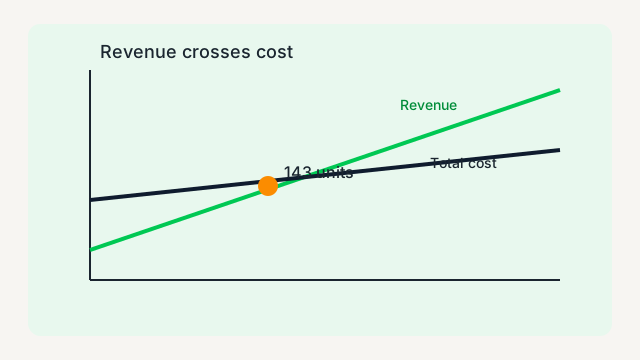
This break-even calculator is an illustration, not a forecast. Straight lines miss the week a supplier raises prices and the month a fixed cost is not fixed. Educational only. Not financial or tax advice. Your real costs move with volume in ways a straight line does not capture.
How to use this calculator
- Pick product or service. The labels switch from units to hours. The formula does not.
- Enter the price and the variable cost of one sale. Leave rent and insurance out of the variable box.
- Enter monthly fixed costs and the profit you want. Read the rounded-up unit counts.
- Enter current sales so margin of safety and profit at today's volume show up.
- Open the price chart, the price-change what-if, and the heatmap before you change a menu price. Leave the sales mix blank unless you sell more than one product.
- Save two scenarios if you are comparing a product line with a service hour.
What the numbers mean
- Contribution margin
- Price minus variable cost. The dollars each sale contributes before rent. The example is $28.00, or 56.00% of the price.
- Break-even units
- Fixed costs divided by contribution margin. 142.86, rounded up to 143, because the last fraction of a sale does not pay the rent.
- Margin of safety
- Current sales minus break-even, divided by current sales. 35.06% at 220 units, which is 77.14 units of room.
- Operating leverage
- Contribution dollars divided by profit. The example is 2.85. A higher number means a small sales drop hits profit harder.
- Sales mix
- A weighted contribution margin. Blank means one product. A 60/40 mix of a $28 margin and a $50 margin is $36.80, and $4,000 divided by $36.80 is 108.70 units.
- Price change
- A side test. At 0% it matches break-even. At 10% on the example it is 121.21 units, and the hero stays at 143.
Worked example: $4,000 fixed costs and a $50 product
The default break-even calculator case is a simple product: $4,000 of fixed costs, a $50 price, $22 of variable cost, 220 units sold, and a $2,000 profit target. Contribution margin is $28.00. The contribution margin ratio is 56.00%. Break-even is 142.86 units, shown as 143, and $7,142.86 of revenue.
The $2,000 target needs 214.29 units, shown as 215, and $10,714.29 of revenue. At the 220 units you already sell, profit is $2,160.00. Margin of safety is 35.06%, or 77.14 units. Degree of operating leverage is 2.85. You are past the line, and not by a huge amount. A slow month can eat that cushion.
On the break-even calculator, spread break-even across 21.7 business days and you need about 6.58 sales a day to cover the month. Daily fixed cost, using 30 calendar days, is $133.33. One extra unit, once you are past the line, adds $28.00 of profit. If you put $10,000 in before the first sale, that profit covers it in about 4.6 months. That payback is arithmetic, not a promise that the next 4.6 months look like this one.
Change one input and the story moves. A $45 price needs 173.91 units to break even and profit at 220 falls to $1,060.00. A $60 price needs 105.26 units and profit rises to $4,360.00. Variable cost up 10%, to $24.20, pushes break-even to 155.04 units. Fixed costs of $5,000 push it to 178.57 units. Same product. Different month.
Break-even formula
The break-even formula is fixed costs divided by contribution margin. Contribution margin is price minus variable cost. Break-even revenue is that unit count times price. Units for a profit target are fixed costs plus the target, divided by the same margin. A break-even calculator is that formula with the rounding and the charts attached.
On the break-even calculator, profit at current sales is units times contribution margin, minus fixed costs. Margin of safety is current units minus break-even units, divided by current units. Operating leverage is units times contribution margin, divided by profit. If profit is zero or negative, leverage is not a useful number, and the page says so instead of printing a nonsense ratio.
If price is not above variable cost, you lose money on every sale. Raising volume makes the hole bigger. The break-even calculator stops and says to raise the price or cut variable cost. There is no heroic unit count that fixes a negative margin.
The rounded-up count on the break-even calculator is the one to plan with. 142.86 units does not pay the last dollars of rent. 143 does, on this straight-line model. The two-decimal figure stays visible so you can see how close the fraction was. A result of 16.00 hours does not need a round-up. A result of 16.01 does.
Contribution margin: the number that matters
Contribution margin is the number a break-even calculator keeps coming back to. It is not your profit. It is the slice of each sale left after the costs that travel with the sale. Fixed costs then take bites out of that slice until they are gone. Whatever remains is profit, before tax and before any pay you forgot to include.
On the break-even calculator the example margin is $28.00 on a $50 price, a 56.00% ratio. Half the price, roughly, is available for rent, insurance, your target pay, and what is left over. A 15% ratio means you are working hard to fund a building. A 50% ratio is the score's comfortable line. Your industry may live somewhere else. The score is a rule of thumb, not a grade of the business.
Watch what you stuff into variable cost. A payment fee that is a percent of the sale belongs there. A contractor you hire only when a job is sold belongs there. Your own base draw, the shop lease, and the annual insurance bill belong in fixed costs, spread across the month. Mix them up and the break-even calculator will give you a tidy wrong answer.
Volume discounts and overtime break the straight line. The first 100 units might cost $22. Unit 250 might cost $30 because you paid rush freight. This page cannot see that step. Use the heatmap as a stress test, then check the real invoice. Contribution margin is only as honest as the variable cost you typed.
Price, volume, and the fastest lever
Price is usually the fastest lever because it changes the margin on units you already sell. On this break-even calculator, $55 instead of $50 drops break-even from 142.86 units to 121.21 and raises profit at 220 units from $2,160.00 to $3,260.00. That is $1,100.00 more in the same month, if customers still buy 220. They might not. The chart does not model a lost sale.
On the break-even calculator, volume is the other lever. You are 77.14 units above the line. Drop to the line and profit is zero, even though the shop still feels busy. Operating leverage of 2.85 means profit moves faster than sales, in both directions. A good month feels better than the sales gain. A bad month feels worse.
The price table walks minus 20% to plus 20% at today's volume. The heatmap crosses price from 0.8 times to 1.2 times with volume from 0.6 times to 1.4 times. Read the cell you are in, then the cell you would land in if price rose and volume fell a little. A higher price that keeps most of the customers wins. A higher price that empties the shop does not, and this break-even calculator will not pretend it knows which one you have.
Cutting variable cost works like a quiet price increase. Ten percent more variable cost, $24.20 instead of $22, moves break-even to 155.04 units. A packaging change or a fee you can drop is often easier than asking for $5 more. Fixed costs matter too. $5,000 instead of $4,000 means 178.57 units. Canceling a tool you do not use is a break-even project.
Break-even for a service business or side hustle
A service break-even is the same formula with hours instead of units. The service chip uses $1,200 of fixed costs, an $85 hour, $10 of variable cost per hour, a $3,000 target, and 40 hours sold. Contribution margin is $75.00. Break-even is 16.00 hours. The $3,000 target needs 56.00 hours. If you only have 40 hours to sell, the target is ahead of the calendar.
That is the side-hustle trap. The margin can look wonderful and the month can still miss because there are not enough hours. A break-even calculator in service mode makes that obvious. Raising the rate from a low starting point often beats hunting for a fifth client you cannot staff. Putting owner pay in the target, not in a fantasy leftover, keeps the hour count honest.
The food truck chip on the break-even calculator is a product with thin dollars and high volume: $6,500 fixed, a $12 price, $4.50 variable, and 1,100 units. Margin is $7.50. You need a lot of tickets. That is normal for food. It is a bad surprise for a consultant who copied a product price. Switch the mode, then read the unit word on the hero before you celebrate a low break-even.
Hours you give away, revisions, and drive time are variable or they are a cap on how many billable hours exist. If they are not in the variable cost, the 16.00 hour line is a story. Track a month of real hours, then come back. The break-even calculator will still be here. It will not bill the client for you.
How long until a new business breaks even?
Months to break even equals your startup costs divided by the monthly profit the business makes after covering its own bills. If you spent $15,000 to launch and the business now clears $2,160 a month, payback takes 15,000 / 2,160, or about 6.9 months. If monthly profit is zero or negative, there is no payback date yet, only a burn rate.
| Monthly profit after fixed costs | Months to pay back |
|---|---|
| $500 | 30.0 |
| $1,000 | 15.0 |
| $2,160 (this page's example) | 6.9 |
| $3,000 | 5.0 |
Real launches ramp, so count the slow months too. Say month one loses $800, month two breaks even, and month three earns $1,000. You are now $15,800 in the hole, not $15,000, and the payback clock really starts at month three. Hopeful owners skip that step every year.
Startup costs people forget to count
- Inventory or materials bought before the first sale
- Equipment, tools, and the laptop you swear is for the business
- Website, software subscriptions, and payment processing setup
- Licenses, permits, insurance deposits, and the LLC filing fee
- Losses from the first few months while sales ramp up
Once you know the monthly burn before break-even, the business runway calculator tells you how many months of cash you have to get there.
From break-even to owner cash flow
Break-even is the floor, not the point of the business. Owner cash flow is what you can take home after the floor, the tax reserve, and the bills that do not care about your model. A break-even calculator gets you to the floor. The habit after that is moving profit on purpose instead of hoping it is what remains on Friday.
Read Profit First cash flow basics for one way to split revenue into profit, owner pay, tax, and operating costs before the month spends itself. Then use tracking business cash flow so the weekly list matches the fixed and variable split you typed here. A number you do not write down gets revised by memory, and memory is generous.
Cash in the bank is not the same as profit. A deposit can be next month's materials. A draw can be this month's rent in disguise. When the break-even calculator says you are 35.06% above the line, check the account before you raise your pay. The $2,160.00 profit in the example is an illustration on a straight line. Tax, a slow payer, and a truck repair are not in that line.
Once the business clears a real surplus, use the break-even calculator as the floor check, then look at where that surplus can earn its own cash flow: a rental, a dividend holding, or a paid-off note. The freedom date is a different tool. This page only answers how many sales fund the shop. Get that answer, then decide what "enough" means for a Tuesday.
Break-even FAQ
How do you calculate a break-even point?
Subtract variable cost from price to get contribution margin, then divide fixed costs by that margin. On this break-even calculator, $50 minus $22 is a $28.00 margin. $4,000 divided by $28.00 is 142.86 units, which rounds up to 143 sales. Revenue at that point is $7,142.86. If the margin is zero or negative, there is no break-even.
What is contribution margin?
Contribution margin is price minus variable cost, the dollars each sale contributes toward fixed costs and profit. The example is $28.00 per unit, a 56.00% contribution margin ratio. A break-even calculator uses that ratio as the engine. A higher ratio means fewer sales cover the same rent, software, and insurance.
How many sales do I need to break even?
At the defaults you need 143 units a month, or $7,142.86 of revenue. To pay yourself a $2,000 target you need 214.29 units, which rounds up to 215, and $10,714.29 of revenue. The break-even calculator rounds the last fraction up because you cannot sell a tenth of a unit and call the month covered.
What is margin of safety?
Margin of safety is how far current sales sit above break-even, as a percent of current sales. At 220 units the cushion is 77.14 units, or 35.06%. A break-even calculator treats 30% or more as a comfortable cushion and zero as the line itself. Below zero you are funding the month from savings.
Should I raise prices or sell more?
A small price change often moves the line more than a small volume change, because price lifts the margin on every unit you already sell. Moving from $50 to $55 drops break-even from 142.86 units to 121.21 and lifts profit at 220 units from $2,160.00 to $3,260.00. Selling more still matters. The break-even calculator shows both so you can pick the lever you can actually pull.
Does break-even include my own pay?
Only if you put that pay in fixed costs or in the profit target. The default $4,000 of fixed costs and the $2,000 target are separate. Profit at 220 units is $2,160.00 before any pay that is not already in those boxes. A break-even calculator will not invent a salary. If you need $2,000 for yourself, use the target and read 215 units. Set the target to 0 and the unit count matches break-even: 142.86, shown as 143.
How does a sales mix change break-even?
Leave the mix blank and this page still prices one product: 143 units and $7,142.86. Fill two products and the margin is a weighted average. A 60% product at $50 with $22 of variable cost and a 40% product at $80 with $30 of variable cost have a weighted margin of $36.80. $4,000 divided by $36.80 is 108.70 units, about $6,739.13 of revenue. The $2,000 target then needs 163.04 units.
What does the price-change box do?
It is a side test. The default is 0%, and the what-if units match break-even. At 10% the $50 price becomes $55, the margin becomes $33, and $4,000 divided by $33 is 121.21 units. The hero break-even stays 143 until you change the price box itself. The share link leaves pc out while the box is 0.
How do you calculate break-even in months?
Divide startup costs by the monthly profit after fixed costs. $15,000 of launch costs and $2,160 a month of profit pays back in about 6.9 months. Add any early months that lost money to the startup total first, because those losses also have to come back.
What is break-even sales in dollars?
Break-even sales in dollars equals fixed costs divided by the contribution margin ratio. $4,000 divided by 0.56 is $7,142.86 a month. A dollar target is easier to track than a unit count when you sell several products at different prices.
Educational only. Not financial or tax advice. Real costs move with volume in ways a straight line does not capture, so treat the unit count as a sketch.