

Dividends · A monthly goal, then the pile
Dividend Income Calculator
Short answer
$1,000 a month at a 3.5% yield takes $342,857 invested. Starting with $25,000 and adding $750 a month with DRIP, you get there in about 15 years 7 months. Chasing an 8% yield only needs $150,000, but that is where dividend cuts live. Income today on the $25,000 is $72.92 a month. This dividend income calculator is for someone sizing a monthly check. The caveat: the yield is an assumption, and a cut moves the date.
Last reviewed: November 19, 2026. Fund yields checked against Schwab and Vanguard, tax brackets against IRS Rev. Proc. 2025-32. Illustration, not a forecast.
Dividend income calculator
This dividend income calculator answers two questions. How much must be invested to collect a monthly dividend goal at a yield you type, and when a starting balance plus new deposits gets there. No tickers and no live prices. Educational only. Not financial advice.
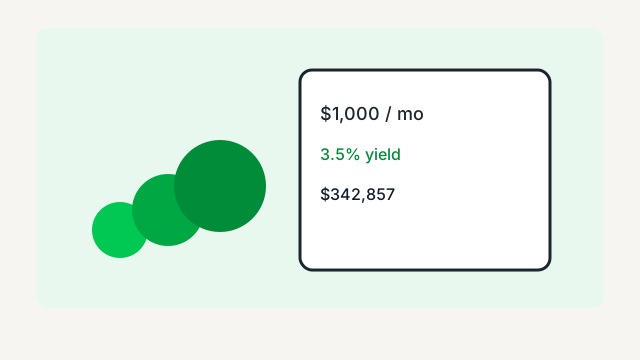
Educational only. Not financial advice. The lines are an illustration, not a forecast.
How to use this calculator
- Type the monthly income you want the dividends to cover.
- Pick a portfolio yield. Start near 3% to 4% unless you have a reason not to.
- Set tax to 0% for a Roth-style account, or about 15% for a taxable qualified-dividend estimate.
- Enter what is invested now and the monthly deposit.
- Leave DRIP on if the dividends stay in the account. Turn it off if you spend them.
- Read the portfolio needed, the goal month, and the yield ladder before you chase a higher yield.
What the numbers mean
- Portfolio needed
- Annual goal divided by the after-tax yield. At $1,000 a month and 3.5% with no tax, $342,857.14.
- Income today
- What the starting balance pays per month. The example is $72.92.
- Goal month
- The first month after-tax income reaches the goal. The example is month 187, 15 years 7 months.
- Yield trap risk
- A text flag on ladder rows above 7%. Very high yields often come with cuts.
- DRIP
- The after-tax dividend goes back into the balance. Off means you took the cash.
Worked example: $1,000 a month at a 3.5% yield
The dividend income calculator opens on a $1,000 monthly goal, a 3.5% yield, and a 0% tax box. The portfolio needed is $342,857.14. A person with $25,000 invested is collecting $72.92 a month, which is 7.3% of the way there if you only look at the starting pile.
They add $750 a month. Price and dividends both grow at 4% a year, so the yield stays 3.5%. DRIP is on. The after-tax income crosses $1,000 at month 187. That is 15 years 7 months. The portfolio that month is $344,911.26, a little above the static $342,857.14 because the last deposit and the last dividend land in the same month.
Check the year marks. End of year 1: value $36,256.73, income $105.75 a month. Year 5: $90,727.69 and $264.62. Year 10: $186,249.37 and $543.23. Same dividend income calculator, three checkpoints, none of them a promise.
How much do you need to invest for $1,000 a month in dividends?
$1,000 a month is $12,000 a year. Divide by the yield and you have the pile. The dividend income calculator prints that pile at several yields so you do not have to trust one row. At no tax: 2% needs $600,000, 3% needs $400,000, 3.5% needs $342,857.14, 4% needs $300,000, 5% needs $240,000, 6% needs $200,000, and 8% needs $150,000.
The 8% row is the one people screenshot. It is also the one this dividend income calculator marks yield trap risk. A yield that high often means the price fell, the payout is stretched, or both. The guide how much to invest for $1,000 a month in dividends walks the same division without the contribution clock.
Tax changes the denominator. At 15% the 3.5% yield keeps only 85% of the cash, so the portfolio needed becomes $403,361.34. The dividend income calculator applies that haircut to the goal and to every month of the projection. It does not file a return for you.
What dividend yield can you get today?
A broad U.S. dividend ETF yields roughly 2.3% to 3.1% in November 2026. Schwab's SCHD showed a 3.13% 30-day SEC yield on November 17, 2026, and Vanguard's VYM showed a 2.29% dividend yield on October 31, 2026. At those yields, $1,000 a month takes about $383,000 to $524,000, which is more than the $342,857 the 3.5% default suggests.
| Yield source | Yield | As of | Invested for $1,000 a month |
|---|---|---|---|
| Vanguard High Dividend Yield ETF (VYM), dividend yield | 2.29% | Oct 31, 2026 | $524,017 |
| Schwab U.S. Dividend Equity ETF (SCHD), trailing 12 months | 2.95% | Oct 31, 2026 | $406,780 |
| SCHD, 30-day SEC yield | 3.13% | Nov 17, 2026 | $383,387 |
| This calculator's default | 3.50% | Assumption | $342,857 |
| 3-month Treasury bill (interest, not dividends) | 4.34% | Nov 18, 2026 | $276,498 |
The T-bill row is there to keep everybody honest. Right now plain cash pays more than the dividend funds do, and for money you need in two years it may simply be the better tool. The trade is growth. A T-bill's $1,000 a month stays $1,000, taxed as ordinary income. A dividend that grew 6% a year would pay about $1,791 a month after ten years, though no fund promises that.
Use the yield you would actually own, then move the slider. If your plan only works at 3.5% and your fund pays 2.95%, the plan is about $64,000 short before you have bought a share.
Sources: Schwab SCHD fund page, Vanguard VYM fund page, U.S. Treasury daily bill rates. Yields change daily; this is not a recommendation to buy any fund.
When will your dividends reach your goal?
The static portfolio is the finish line. The month you arrive depends on the starting balance, the deposit, the growth rate, the tax, and DRIP. The dividend income calculator walks month by month. Each month it takes a dividend from the opening balance, grows the balance, adds the deposit, and adds the after-tax dividend if DRIP is on. Income is then the new balance times the after-tax yield, divided by 12.
On the example that crossing is month 187. Change the deposit to $1,500 and it is month 127. Change the goal to $3,000 and it is month 333. Turn DRIP off and the original goal takes month 247. Put a 15% tax on the original path and the month is 214. If no combination clears the goal inside 100 years, the dividend income calculator says not within 100 years instead of inventing a date.
Share-by-share buying, with different yields on each lot, is a different tool. Use the dividend snowball calculator when the portfolio is a list of names rather than one blended yield.
A note on the year table. Contributed cash is the starting balance plus every monthly deposit. Dividends that year are the gross dividends the model took from the opening balance each month, before tax and before DRIP. Monthly income is the after-tax figure at the end of that year. The dividend income calculator does not smooth a bad quarter. It assumes the yield you typed shows up every month, which is the optimistic version of a dividend check.
Why the highest yield is not the best answer
A yield is last year's cash divided by today's price, or an estimate of next year's cash. It is not a contract. The dividend income calculator keeps the yield constant on purpose so you can see the math. Real companies cut, freeze, and raise. A price drop can make yesterday's safe yield look enormous without paying you one extra dollar.
That is why rows above 7% say yield trap risk in text, not only in a color. Very high yields often come with cuts. The page on yield versus payout is the longer version: a payout ratio and a payment history tell you more than a single percent. Use the dividend income calculator to see how much capital each yield demands, then go check whether that yield has survived a recession.
Chasing 8% to shrink $342,857.14 down to $150,000 feels clever until the dividend is halved. Then you are back near a 4% portfolio with less capital than the boring plan required. The dividend income calculator will happily show the small number. It will also keep the warning on the row.
Taxes, Roth accounts, and DRIP
Where the shares live changes the cash you can spend. A Roth-style account is why the tax box starts at 0%. A taxable account often owes something on qualified dividends. The dividend income calculator uses one flat percent, not a bracket. At 15% you need $403,361.34 instead of $342,857.14, and the example path takes 214 months instead of 187. Estimates, check with a tax pro. The plain-language version is dividend income basics.
DRIP is a toggle, not a virtue. On, the after-tax dividend joins the balance and future income grows faster. Off, you spent it, and the dividend income calculator takes 247 months on the example instead of 187. If the goal is income you live on, DRIP off is the honest setting once you are spending. Before that, DRIP on is how the pile compounds.
Growth is one number for price and for the dividend, so the yield does not drift. If you expect dividends to grow faster than the price, this dividend income calculator will not show that split. It will show a steady yield and a balance that compounds at the rate you typed. Move the growth slider before you treat 4% as a schedule.
The retiree chip is the other end of the same dividend income calculator. Start with $400,000, add nothing, and ask for $1,500 a month. At 3.5% and no tax the static pile for $1,500 is larger than $400,000, so the date depends on growth and DRIP rather than new savings. That is a useful stress. A plan that only works if you keep a job deposit forever is a job plan. A plan that works after the deposit stops is closer to the income you meant.
The 0% bracket for qualified dividends in 2026
Federal tax on qualified dividends is 0% while total taxable income stays at or below $49,450 for a single filer or $98,900 for a married couple filing jointly in 2026. Above that the rate is 15% up to $545,500 single or $613,700 joint, then 20%. A married couple with $60,000 of other taxable income and $12,000 of qualified dividends lands at $72,000, inside the 0% band, so the tax box here can honestly stay at 0%. State tax may still apply. Source: IRS Rev. Proc. 2025-32.
Dividend income FAQ
How much do I need to invest to make $1,000 a month in dividends?
The dividend income calculator divides $12,000 a year by the after-tax yield. At 3.5% and no tax, that is $342,857.14. At 2% it is $600,000. At 4% it is $300,000. At 8% it is $150,000, and that row is marked yield trap risk because very high yields often come with cuts.
What dividend yield should I use?
Use a yield you can picture keeping, not the highest number on a screener. The dividend income calculator starts at 3.5%. The ladder also shows 2%, 3%, 4%, 5%, and 6%. Anything above 7% gets a yield trap risk note. A yield is an assumption. It is not a forecast and not a quote.
How long does it take to live off dividends?
On the dividend income calculator, $25,000 already invested plus $750 a month, 4% growth, and DRIP reaches $1,000 a month at month 187 (15 years 7 months). The portfolio then is $344,911.26. Income today is only $72.92 a month. Raise the deposit to $1,500 and the month is 127. A $3,000 goal takes month 333. Turn DRIP off and the $1,000 goal slips to month 247.
Should I reinvest dividends?
DRIP adds the after-tax dividend back into the balance, so the next month's income is a bit larger. The dividend income calculator's default path uses that. The same path with DRIP off takes 247 months instead of 187. If you are already spending the dividends, leave DRIP off. The model will not reinvest cash you needed for rent.
Are dividends taxed?
Often, outside a Roth or similar account. The dividend income calculator defaults the tax box to 0%. At 15% the portfolio needed rises from $342,857.14 to $403,361.34 and the goal month moves from 187 to 214. Those are estimates, check with a tax pro. The primer is dividend income basics.
Is a high dividend yield good?
A higher yield shrinks the portfolio, and it also concentrates the cut risk. The dividend income calculator needs $150,000 at 8% for $1,000 a month, versus $342,857.14 at 3.5%. The 8% row is labeled yield trap risk. Read yield versus payout before you treat a fat yield as a bargain.
How much do I need in SCHD to make $1,000 a month?
At SCHD's 3.13% 30-day SEC yield on November 17, 2026, $1,000 a month takes about $383,387. At its 2.95% trailing yield on October 31, 2026, it takes about $406,780. Yields move with price and payouts, so recheck before you plan around either number. This is an illustration, not a recommendation to buy the fund.
What is the 0% dividend tax bracket for 2026?
Qualified dividends are taxed at 0% federally when total taxable income is $49,450 or less for a single filer, $66,200 for head of household, or $98,900 for married filing jointly in 2026, per IRS Rev. Proc. 2025-32. The 15% rate runs to $545,500 single or $613,700 joint. Ordinary dividends use regular income tax brackets.
More free tools: DRIP · Dividend tax · Dividend calendar
Educational only. Not financial advice. Dividends can be cut, and yields and growth are assumptions, not forecasts.