

Debt · Snowball or avalanche, same extra
Debt Snowball Calculator
Short answer
The debt snowball pays the smallest balance first. The avalanche pays the highest interest rate first. Both pay every minimum and roll each freed-up minimum into the next debt. Five made-up debts total $47,550. Minimums are $900. Add $300 a month and both the debt snowball and the avalanche are debt-free in 46 months (3 years 10 months). The avalanche saves $406.23 of interest. The snowball knocks out the second debt 9 months sooner, month 12 instead of month 21. This page is for someone with several balances and one extra payment who wants the order, not a pep talk. The caveat: minimums only, with no rollover, take 120 months and $15,510.39 of interest, and a new card restarts the clock.
Last reviewed: November 19, 2026. Illustration, not a forecast.
Debt snowball calculator
It answers which order frees a payment sooner, and which order keeps more interest in your pocket. Someone staring at a pile of statements, not a single mortgage, is who this is for. The debts below are a made-up example, not anybody's real accounts, and the caveat is that a new balance undoes the plan. Educational only. Not financial advice.
How to use this debt snowball calculator
- Start with the example debts, or replace the names, balances, rates, and minimums with the pile on your own statements.
- Set the extra payment you can send every month, plus any one-time lump that lands in month 1.
- Read snowball, avalanche, and your order side by side. Your order is the row order. Drag a row, or use the up and down buttons, to change it.
- Compare interest and months with the slower of those three plans. Minimums only stays the baseline, and it does not roll a dead payment forward.
- Open the month-by-month payoff calendar. Show every month, then print the page or save the CSV.
- Copy the link if you want the same debts again. The link keeps the old keys. A custom order uses the existing order key only when the rows are not the example order.
What the numbers mean
- Snowball
- Smallest starting balance first. Ties go to the higher rate. On the default mix with $300 extra, that is 46 months and $7,362.45 of interest.
- Avalanche
- Highest rate first. Ties go to the smaller balance. Same 46 months, interest $6,956.22, which is $406.23 less than the snowball.
- Your order
- The row order you set yourself. On the example rows that is 46 months and $7,040.06 of interest, $322.39 less than the snowball. Snowball and avalanche ignore this order.
- Slower plan
- Whichever of those three takes more months. If the months match, it is the one with more interest. Months saved and interest saved are measured against that plan.
- Minimums only
- Each debt pays only its own minimum. No rollover and no extra. The example takes 120 months and $15,510.39 of interest.
- Payoff calendar
- One row per month: what each debt was paid, and what balance is left. Year totals stay on the page. Print includes the monthly rows.
Debt snowball vs avalanche: the real difference
With $300 extra, the interest gap is $406.23 and the finish line is the same month. The snowball's second win lands in month 12. The avalanche does not clear that same debt until month 21.
That is the honest story on a mixed pile of cards and installment loans. The method is a tie-breaker. The extra payment, and the rollover after each payoff, do the heavy lifting. Minimums only, with no rollover, cost $15,510.39 and take 120 months.
| Plan | Months | Interest | First win | Versus minimums |
|---|---|---|---|---|
| Snowball | 46 | $7,362.45 | Month 3 | $8,147.94 less interest |
| Avalanche | 46 | $6,956.22 | Month 3 | $8,554.17 less interest |
| Minimums only | 120 | $15,510.39 | Month 35 | Baseline |
What debt actually costs in 2026
| Debt | Average rate | Example in the calculator |
|---|---|---|
| Credit card, accounts paying interest (Aug 2026) | 22.36% | 22.9% card, 24.99% store card |
| New car, 72-month loan at a bank (Aug 2026) | 7.17% | 6.9% car loan |
A $6,200 balance at 22.36% grows about $116 a month in interest alone, before the bank sees a dime of principal. That's why the avalanche goes after cards first. Source: Federal Reserve G.19.
Pick the one you'll stick with. The money difference is small. Change the balances above if your pile looks different. A single expensive card can flip this paragraph. That case is below.
Worked example: $47,550 across five debts
Same debts as the calculator's starting rows. Store card $850 at 24.99% (minimum $35). Credit card $6,200 at 22.9% ($155). Car loan $14,500 at 6.9% ($340). Student loan $22,000 at 5.5% ($240). Personal loan $4,000 at 11.5% ($130). Extra payment $300. No lump sum. Illustration, not a forecast.
| Debt | Snowball | Avalanche | Minimums only |
|---|---|---|---|
| Store card | 3 | 3 | 35 |
| Personal loan | 12 | 21 | 37 |
| Credit card | 22 | 17 | 77 |
| Car loan | 31 | 31 | 50 |
| Student loan | 46 | 46 | 120 |
Snowball order follows the starting balance, smallest first. Ties would go to the higher rate. Avalanche follows the rate, highest first. Ties would go to the smaller balance. Interest is added on the balance at the start of the month, then the payment lands.
Turn the extra to $0 and both plans take 67 months. Avalanche saves $1.23. Raise the extra to $600 and both finish in 36 months, avalanche interest $5,148.49 versus snowball $5,437.59. The rollover still happens with $0 extra, because each dead minimum joins the next debt. Minimums only does not do that.
How the debt snowball works
You pay every minimum, then throw the extra dollar at the smallest balance. When that one is gone, its minimum joins the attack on the next smallest. The rate is not the boss. The win is.
In the example the store card dies in month 3 either way, because $35 plus a slice of the extra chews through $850 fast. The personal loan is the second-smallest balance, so the snowball finishes it in month 12. The avalanche is still busy with the credit card then, and does not clear the personal loan until month 21.
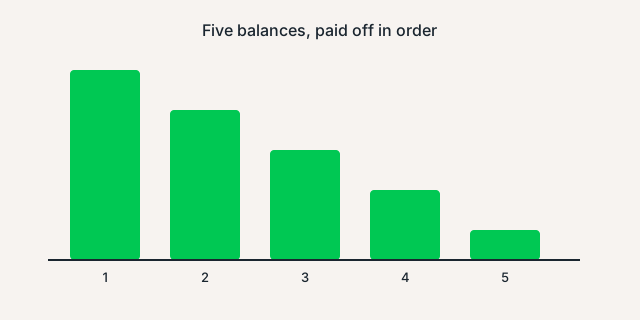
People stick with a plan that gives them a finished account. A spreadsheet that saves $406 and feels endless often loses to a plan you actually run. That is not a pep talk. It is why the second-win column is on this page.
How the debt avalanche works
Same budget, different target. After minimums, the extra goes to the highest APR. When that balance is gone, the next-highest rate gets the pile.
On the default mix the credit card (22.9%) is the avalanche's main job after the tiny store card. It is gone in month 17, five months before the snowball gets there. The student loan at 5.5% waits until month 46 either way, because it is both large and cheap. You do not need a slogan for that. The rate already sorted it.
If two debts share a rate, the smaller balance goes first, so you still get a finished account as soon as the math allows. "Your order" in the schedule ignores both rules and follows the row order you set with Up and Down.
When the avalanche wins big
Swap the $6,200 card for a $15,000 card at 27.9% with a $375 minimum, leave the other four debts alone, and keep the $300 extra. Now the method matters.
Snowball: 52 months, interest $17,137.23. Avalanche: 49 months, interest $13,221.47. The avalanche saves $3,915.77 and three months. Load "Big credit card" above and the cards will match those figures.
The avalanche saves real money here. If you need quick wins, knock out the tiny balance first, then switch to avalanche. The store card is still gone in a few months. After that, the 27.9% balance is the fire. A 6.9% car loan can wait.
Why paying off debt is a cash flow move
Every minimum you kill is monthly cash flow you get back. In the default example that is $900 of minimums, freed by month 46, if you do not replace them with a new payment.
$900 a month is real money. It is also not a paycheck until the last debt is gone and you actually keep the cash. Spending the freed minimum on a new truck puts you back in the table. Point it at the next debt while you are still in the plan. After month 46, point it at assets that pay you.
A first chunk of monthly cash flow is the idea behind your first $500 a month. The bigger "what would it take to leave a job" question is on how much cash flow to quit your job. Debt payoff is the part where you stop shipping $900 to lenders before you try to replace a paycheck.
Common debt payoff mistakes
The calculator assumes you keep paying, and that you do not open a new balance. Real life breaks both of those. Here are the usual ways the 46-month picture dies.
- Stopping the rollover. When the store card dies, its $35 wants to wander off to dinner. Leave it in the payment. That is the snowball.
- Adding new card debt. A payoff plan plus a new $2,000 TV is just a slower payoff plan. The chart will not save you from the receipt.
- Skipping an emergency fund. One car repair on a credit card restarts the high-rate balance you just killed. A small cash buffer is part of the plan, not a delay.
- Ignoring 0% promo end dates. A teaser rate that jumps to 28% is not a 0% loan. Put the end date on a calendar. This tool uses one flat APR per debt.
- Paying a 3% loan before high-rate cards. That is a snowball aimed at the wrong target if the cheap loan is also the small one, or a pride payoff. Check the interest column before you do it.
Real minimums often shrink as the balance falls, and promo rates end. The fixed minimums here are an illustration. Check your statements.
Frequently asked questions
Is the debt snowball or avalanche better?
On the default mix, neither one is magic. Both are debt-free in 46 months. The avalanche saves $406.23 of interest. The debt snowball pays off the second debt in month 12 instead of month 21. If a plan with no early win would get abandoned, take the snowball. If either plan will actually get finished, take the $406.
How much does the avalanche method save?
With $300 extra on these five debts, $406.23. With no extra, about $1.23. With a $15,000 card at 27.9%, the avalanche saves $3,915.77 and finishes 3 months sooner (49 months vs 52). The gap stays small until a big balance is carrying a high rate.
How does a debt snowball calculator work?
Each month, interest hits the starting balance, then every debt gets its minimum. Whatever is left, including the extra payment, goes to one target. Snowball aims at the smallest balance. Avalanche aims at the highest rate. When a debt dies, its minimum keeps working on the next one. That rollover is the whole trick, and it is less glamorous than the name.
What is the average credit card interest rate in 2026?
About 22.4%. The Federal Reserve's G.19 report put the average rate on credit card accounts that actually pay interest at 22.36% for August 2026. That is why the 22.9% card in the example sits near the front of the avalanche line. A new 72-month car loan at a bank averaged 7.17% in the same report, which is why the car loan waits its turn.
Should I include my mortgage?
You can, but a 3% mortgage next to a 23% card will just sit at the back of the line, which is where it belongs. This debt snowball calculator is built for the expensive stuff: cards, car loans, personal loans, and student loans. A rental mortgage is a different question. Compare terms on the mortgage comparison calculator instead of snowballing a cheap loan.
What extra payment should I use?
Use money you can send every month without putting the groceries on a card. In the example, $300 extra turns a 120-month minimums path into 46 months. $600 extra finishes in 36 months. A one-time lump sum lands in month 1 only. The calculator does not know the rent or the emergency fund.
Should I pay off debt or invest?
A 23% card is a nasty bill. Paying it is a sure 23% in the other direction, which beats most honest investment illustrations. A 4% student loan is a slower decision, and the math can favor investing once the high-rate balances are gone. This page does not pick for you. Run both numbers, and keep an emergency fund so a flat tire does not become a new card.
What is your order on the debt snowball calculator?
Your order is the row order, including drag and the up and down buttons. On the default five debts with $300 extra, that order finishes in 46 months and charges $7,040.06 of interest. That is $322.39 less than the snowball and $83.84 more than the avalanche. All three finish in month 46, so the months saved versus the slower plan are zero. Snowball and avalanche keep their own sort. They do not follow this row order.
Where is the month-by-month payoff calendar?
The calendar is the table under the calculator. Year totals stay visible, and Show every month opens each month. Print / save PDF includes those rows. The kit table above it lists every month for the method you selected, with a payment and a balance for each debt.
More free loan and debt tools: 15 vs 30 year mortgage, DSCR loan, HELOC, rent vs buy, cash-out refinance. See the full loans and debt list.
Educational only. Not financial advice. Real minimums often shrink as balances fall, and promo rates end. Check the statements before you trust a finish date.