

Real estate · NOI divided by price
Cap Rate Calculator
Short answer
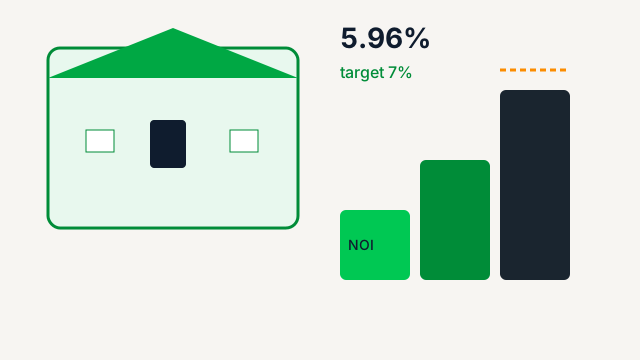
Cap rate is net operating income (rent minus vacancy and operating costs, with the mortgage left out) divided by the price. This answers what a rental earns before the loan, for anyone comparing buildings that will not share a mortgage. A $250,000 rental at $2,100 a month produces $14,904 of NOI, a 5.96% cap rate. At a 7% target the same income is worth $212,914. The 8.96% mortgage constant is higher than the cap rate, so this sketch loses about $1,889 a year with 25% down. The loan rate is an example: Freddie Mac PMMS for the week of Nov 5, 2026 was 7.18% on a 30-year, plus 1 point, shown here as 8.18%.
Last reviewed: November 19, 2026. Mortgage rate checked against Freddie Mac PMMS (Nov 19, 2026), market cap rates against CBRE H1 2026. Illustration, not a forecast.
Cap rate calculator
If you are pricing a building against other buildings, start here. Rent and operating costs become NOI, then a cap rate, then a price at the cap rate you want. The mortgage sits beside those numbers. It is not inside them. Educational only. Not financial advice.
The Cash Flow Scout
Cap rate calculator
Educational only. Not financial advice. Example rates, get real quotes.
NOI over time
Income vs expenses
Value versus cap rate
Expenses
Run full cash flow in the SFR Rental Calculator Multifamily? Use the Multifamily Rental Calculator
How to use this calculator
- Enter the price and the monthly rent. Those two numbers do most of the work, and a wrong rent ruins both.
- Set vacancy, management, repairs, CapEx, tax, and insurance. The page turns them into NOI.
- Move the target cap rate slider. Value at that target is NOI divided by the rate. It starts at 7%.
- Leave NOI growth at 0 if you only want this year. The line stays flat until you move it.
- Use the loan fields when you want the mortgage constant next to the cap rate. The loan is not inside the cap rate.
- Read income versus expenses, then the price the target cap rate would support. If the list is higher, that is the gap, not a rounding error.
What the numbers mean
- Cap rate
- NOI divided by price. On the defaults that is $14,904 divided by $250,000, or 5.96%. The mortgage is not in it, which is the whole point.
- NOI
- Effective income minus operating expenses. The default is $14,904 a year. Debt service stays out, so two buyers can share this number.
- Value at target
- NOI divided by the target cap rate. At 7%, $14,904 divided by 0.07 is $212,914. That is what the income supports, not what the seller is asking.
- Mortgage constant
- Annual loan payment divided by the loan. The default is 8.96%. When it sits above the cap rate, that is negative leverage: the debt costs more than the property earns.
- GRM
- Price divided by annual gross rent. The default is 9.92. It ignores vacancy and expenses, so use it as a glance, then come back to NOI.
Worked example: $250,000 rental at $2,100 rent
The cap rate calculator starts with $2,100 a month. Times 12, gross potential rent is $25,200. Vacancy of 5% removes $1,260, so effective gross income is $23,940. Other income is zero in the example.
Management at 8% of gross rent is $2,016. Repairs at 5% are $1,260. CapEx at 5% is another $1,260. Tax is $3,000 and insurance is $1,500. Operating expenses add to $9,036. NOI is $23,940 minus $9,036, which is $14,904. Expense ratio is 37.74% of effective income. GRM is 9.92.
Cap rate is $14,904 divided by $250,000, or 5.96%. If rent falls 10%, the cap rate calculator drops to 5.19%. If rent rises 10%, it rises to 6.74%. A heatmap cell at $1,900 rent and a $225,000 price is 5.80%. $2,300 rent on $225,000 is 7.45%. $2,300 on $275,000 is 6.09%.
How to calculate cap rate
Cap rate equals NOI divided by price. NOI is the rent you actually expect, plus other income, minus vacancy, taxes, insurance, management, repairs, reserves, and owner-paid HOA or utilities. The cap rate calculator applies vacancy to rent only, the same way the SFR page does after its vacancy fix. A dollar of laundry income is not haircut by the vacancy percent.
The mortgage payment is not an operating expense. Put it in NOI and you no longer have a cap rate. You have a muddled cash flow that cannot be compared with the house next door if the loans differ. The longer walk-through is cap rate versus cash flow.
Gross rent multiplier is the blunt cousin: price divided by annual gross rent, before vacancy and expenses. On this example it is 9.92. It is useful for a first pass and useless if one house has a tax bill twice as large as the other. That is why the cap rate calculator still builds the full NOI.
What is a good cap rate?
A good cap rate is the one that pays you for the risk you are actually taking. A newer house on a quiet street can trade at a lower cap rate than a tired fourplex on a busy road, and both prices can be rational. The cap rate calculator will not invent a market average. It will tell you whether your NOI hits the target you typed.
| Property type | Wide band |
|---|---|
| Single-family (illustrative, not a quote) | 4% to 7% (illustrative, not a quote) |
| Small multifamily, 2 to 4 units (illustrative, not a quote) | 5% to 8% (illustrative, not a quote) |
| Larger multifamily (illustrative, not a quote) | 5% to 9% (illustrative, not a quote) |
| Short-term or vacation rental (illustrative, not a quote) | 6% to 12% (illustrative, not a quote) |
| Small retail (illustrative, not a quote) | 6% to 10% (illustrative, not a quote) |
The bands are wide on purpose. A local survey can land inside them, or it can miss. The default deal on this page is 5.96%, which sits in the single-family illustration. That does not tell you to buy the house.
Price and rent do not move in lockstep. The same NOI at a higher price is a lower cap rate, full stop. The page on cap rate by price range shows that pattern with labeled assumptions. Bring your own tax bill. A table from another city will not know it.
If you want a rule you can say out loud: decide the cap rate before you fall in love with the kitchen. Then let the cap rate calculator solve the price. Arguing about whether 6% is "good" after you already offered $250,000 is how people talk themselves into negative leverage.
What are cap rates right now (2026)?
Cap rates held roughly flat through the first half of 2026, according to CBRE's H1 2026 Cap Rate Survey, which pooled 3,600 estimates across more than 50 U.S. markets. About 60% of respondents expected no change over the next six months, yet more of them expected cap rates to rise than in December 2025, and infill apartments drew the gloomiest outlook.
A national average will not price your duplex. What it does give you is a yardstick, and the most useful yardstick is the spread between your cap rate and what money earns elsewhere.
| Benchmark | Rate | As of | What it says about a 5.96% cap |
|---|---|---|---|
| 10-year Treasury | 5.07% | Nov 18, 2026 | Only 0.89 point of extra pay for tenants, roofs, and vacancy |
| 30-year mortgage (Freddie Mac PMMS) | 7.28% | Nov 19, 2026 | Owner-occupant rate with 20% down; investors usually pay more |
| Investor loan sketch (PMMS plus 1 point) | 8.28% | Nov 19, 2026 | 9.04% mortgage constant, so leverage is negative by about 3.1 points |
| Stabilized New York City apartments (CBRE) | 5.0% to 5.5% | H1 2026 | Up from 4.5% to 5.0% in late 2025; big-city buildings still trade below this house |
Read the first row twice. A government bond pays 5.07% and never calls you about a clogged drain. A rental that pays 5.96% before the loan is asking you to do real work for less than one extra point. How big a premium you demand is your call, but decide it before the tour, not after the kitchen.
How to find cap rates for your own town
- Ask a local commercial or multifamily broker for recent closed sales with the actual NOI, not the asking price and a pro forma.
- Rebuild NOI yourself with the county's real tax bill and your own insurance quote. Listing NOI tends to forget both.
- Compare closed sales of the same type and age. A 1970s fourplex and a new townhouse do not share a cap rate.
- Run every comp through this calculator so the vacancy and expense percents match, then compare like with like.
Sources: CBRE U.S. Cap Rate Survey H1 2026, Freddie Mac PMMS, U.S. Treasury daily yield curve.
Use cap rate to price a property
Value at a target cap rate is NOI divided by that rate. The cap rate calculator uses 7% unless you move the slider. $14,904 divided by 0.07 is $212,914. Paying $250,000 means you accepted a 5.96% cap rate, whether or not you wrote that sentence down.
The ladder keeps the NOI still and moves only the rate. Five percent supports $298,080. Six percent supports $248,400. Seven percent is $212,914. Eight percent is $186,300. Nine percent is $165,600. Ten percent is $149,040. Same building, six opinions about risk.
The rent that hits your target, with expenses held at these percents, is a different lever. The stat strip solves it in a straight line. If the percent expenses eat the margin, the solver says so instead of inventing a rent. Change a percent and run it again. The cap rate calculator does not pretend repairs stay flat when rent doubles unless you set them that way.
Cap rate vs your mortgage rate (positive and negative leverage)
The loan on the default is 75% of $250,000, or $187,500. At 8.18% for 30 years the payment is $1,399.41 a month. Twelve payments divided by the loan is an 8.96% mortgage constant. The cap rate is 5.96%. Spread is about -3 points. That is negative leverage: the property earns less than the loan costs, so this deal loses about $1,889 a year with 25% down.
Positive leverage is the other way around. If the cap rate sits at least a point above the constant, the borrowed dollars earn more than they cost, before taxes and before the repairs you forgot. The cap rate calculator scores that spread. A zero at -2 points and a full score at +1 point. The table also shows LTV 0, 50, 65, 75, and 80 so you can see cash flow move when the loan shrinks. All-cash cash flow equals NOI, because there is no payment.
The 8.18% rate is an example, not a lender sheet. It is Freddie Mac's PMMS of 7.18% for Nov 5, 2026 plus 1 point for an investor loan. On November 19, 2026 the PMMS rose to 7.28%, so the same markup gives 8.28%: a $1,412.58 payment, a 9.04% mortgage constant, and about -$2,047 a year with 25% down. A tenth of a point moved this deal about $158 a year the wrong way. Get a real quote before you treat the constant as yours. Closing costs are ignored in the cash-on-cash line here. The SFR tool is the place for those dollars.
What cap rate does not tell you
A cap rate is a snapshot of one year of NOI and one price. It does not know that the roof is due in year three, that rent might grow, or that you will sell into a different cap rate. The cap rate calculator will not stretch a 10-year IRR for you. It will show the first-year picture clearly, which is the part people skip.
Financing changes the cash you take home and does not change the cap rate. That is the whole point of keeping the loan out of NOI. Read cap rate versus cash flow if those two numbers keep getting swapped in conversation. When you are ready for the payment, reserves, and cash-on-cash with closing costs, open the SFR rental calculator. The button above the results carries price, rent, monthly tax, monthly insurance, vacancy, management, CapEx, and a repairs dollar amount.
Self-managing changes the cap rate because management is a real expense when someone else does it. The stat "cap rate if you self-manage" zeros that percent and leaves the rest alone. It does not add a salary for your Saturday afternoons. If your time has a price, put it back in.
Cap rate FAQ
How do you calculate cap rate?
The cap rate calculator divides NOI by price. On the defaults, gross rent is $25,200. After 5% vacancy, effective income is $23,940. Operating expenses are $9,036. NOI is $14,904. Divide by $250,000 and the cap rate is 5.9616%, which rounds to 5.96%.
What is a good cap rate for a rental?
There is no universal good cap rate. A 5.96% result can be fine in one town and thin in another. The cap rate calculator compares your number with a target you type, default 7%. At that target the same NOI supports $212,914, not $250,000. Use local rent, tax, and insurance, not a national slogan.
Does cap rate include the mortgage?
No. The cap rate calculator keeps the loan out of NOI on purpose. The default loan is $187,500, the payment is $1,399.41 a month, and the mortgage constant is 8.96%. Those numbers sit next to the cap rate. They do not go inside it.
Is a higher cap rate better?
A higher cap rate means more NOI per dollar of price. It does not mean a safer building. The cap rate calculator will show 6.74% if rent is 10% higher and 5.19% if rent is 10% lower, on the same $250,000 price. Risk, repairs, and the neighborhood still matter.
What is the difference between cap rate and cash-on-cash return?
Cap rate uses NOI and price. Cash-on-cash uses cash flow after the loan and the cash you put in. On the defaults the cap rate calculator shows annual cash flow of -$1,888.90 and cash-on-cash of -3.02% on the $62,500 down payment. Closing costs are left out of that down payment, so the cash-on-cash figure is a sketch.
How do I find the price for a target cap rate?
Divide NOI by the target rate. $14,904 divided by 0.07 is $212,914.29. The cap rate calculator ladder for the same NOI is $298,080 at 5%, $248,400 at 6%, $212,914 at 7%, $186,300 at 8%, $165,600 at 9%, and $149,040 at 10%.
What is negative leverage?
Negative leverage means the cap rate is below the mortgage constant. Here 5.96% versus 8.96%. The cap rate calculator calls that out: every borrowed dollar costs more than the property earns. Annual cash flow is about -$1,889 with 25% down. You would be betting on rent growth or a lower price, not on today's spread.
What do the property-type cap rate bands mean?
The table is a wide illustration, not a quote. Single-family is shown as 4% to 7%. Small multifamily is shown as 5% to 8%. Your 5.96% result can sit inside a band and still be the wrong price for one street. Use your NOI and your target.
Why is the NOI line flat?
Growth starts at 0, so NOI stays $14,904 each year on the default deal. That is a flat illustration, not a forecast. Move the growth slider if you want a later year to differ. The cap rate itself still uses this year's NOI and the price.
What is a good cap rate in 2026?
There is no single good number, but the spread is a fair 2026 test. With the 10-year Treasury at 5.07% on November 18, 2026 and investor mortgages near 8.3%, a 5.96% cap rate earns less than the loan costs. CBRE's H1 2026 survey put stabilized New York City apartments at 5.0% to 5.5%. Compare against closed sales in your own market, not a national figure.
Is a 10% cap rate good?
A 10% cap rate means $10,000 of NOI for every $100,000 of price. On this page's $14,904 NOI that is a $149,040 price. It clears today's roughly 9% investor mortgage constant, so leverage turns positive. A cap that high often comes with an older building, softer rent, or repairs the seller already priced in, so verify the expenses first.
More free tools: Depreciation · CapEx reserve · Rental portfolio
Educational only. Not financial advice. Cap rates vary by market, property, and risk, and a number inside a band can still be the wrong price for one street. Example rates, get real quotes.