

Dividends · The bill before you spend it
Dividend Tax Calculator (2026)
Short answer
A single filer with $85,000 of wages pays 15% on $6,000 of qualified dividends and 22% on $1,500 of non-qualified dividends. This dividend tax calculator puts the bill at $1,230.00, a 16.40% effective rate, and $6,270.00 left. The same dollars filed jointly cost $180.00. This page is for someone who wants the tax before they spend the dividend. Planning ahead? In 2027 the single 0% band rises to $51,050 and the joint band to $102,100. Brackets move, and this is not your tax return.
Last reviewed: November 17, 2026. 2026 bands from IRS Rev. Proc. 2025-32; 2027 bands from Rev. Proc. 2026-35. Illustration, not a forecast.
Dividend tax calculator
This dividend tax calculator stacks 2026 qualified dividends on ordinary income, taxes non-qualified dividends at ordinary brackets, and adds the 3.8% net investment income tax when income is over the line. The default single filer pays $1,230.00 on $7,500 of dividends. Educational only. Not financial advice. Not tax advice.
The dividend tax calculator is a 2026 federal estimate. It does not model AMT, credits, the additional Medicare tax on wages, or a real state bracket. If dividends are zero, the effective rate reads n/a instead of dividing by zero.
How to use this calculator
- Pick a filing status on the dividend tax calculator. The standard deduction and the bands move with it.
- Enter wages, qualified dividends, and non-qualified dividends separately.
- Leave state at 0% or type a flat rate. Switch to itemized only if you do not take the standard deduction.
- Read the 0%, 15%, and 20% split before you read the single effective rate.
- Open the drag chart if you want the Roth comparison. It uses the effective rate you just calculated.
- Try Married joint and $40,000 wages. Same dividends, different bands.
What the numbers mean
- Ordinary taxable income
- $70,400.00 on the default. Wages plus non-qualified dividends, minus the $16,100 standard deduction.
- Qualified split
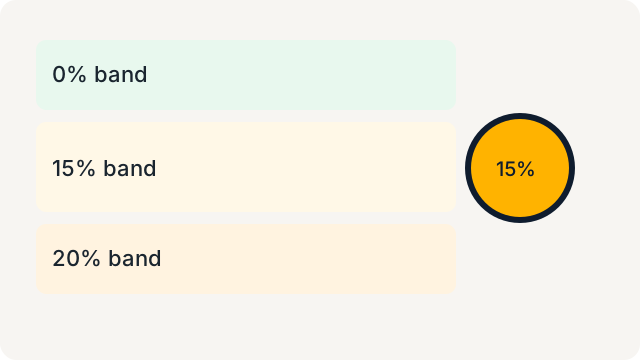
- $0.00 at 0%, $6,000.00 at 15%, $0.00 at 20%. Qualified tax is $900.00.
- Effective rate
- 16.40%. $1,230.00 of tax divided by $7,500 of dividends. After-tax dividends are $6,270.00, or $522.50 a month if the year were even.
- Tax drag
- $78,936.92 over 20 years on a $200,000 portfolio. Roth ends at $773,936.89. Taxable at 16.40% ends at $694,999.97. A flat 15% ends at $701,427.79.
Worked example: $85,000 wages, $7,500 of dividends
The default on this dividend tax calculator is a single filer, $85,000 of wages, the $16,100 standard deduction, $6,000 of qualified dividends, $1,500 of non-qualified dividends, and a 0% state rate. Ordinary taxable income is $70,400.00. Add the qualified dividends and total taxable income is $76,400.00.
The qualified $6,000 sits entirely in the 15% band. Qualified tax is $900.00. The non-qualified $1,500 is the slice that pushes ordinary income from the tax on wages alone into the 22% bracket, so non-qualified tax is $330.00. NIIT is $0.00 because wages plus dividends are $92,500, under the $200,000 single threshold. State tax is $0.00. Total tax on the dividends is $1,230.00. You keep $6,270.00. The effective rate is 16.40%, higher than 15% because the REIT-style slice is ordinary income.
File the same wages and the same dividends jointly and the picture changes. The joint standard deduction is $32,200 and the 0% qualified band reaches $98,900. Qualified tax falls to $0.00. Non-qualified tax is $180.00. Total tax is $180.00, a 2.40% effective rate. Status is not a trivia setting. It moves the bands.
Two more checks live on the chips. At $40,000 of wages, still single, all $6,000 of qualified dividends are in the 0% band and the total bill is $180.00, which is the ordinary tax on the non-qualified slice. At $230,000 of wages with $20,000 qualified and $5,000 non-qualified, qualified tax is $3,000.00, non-qualified tax is $1,600.00, NIIT is $950.00, and the total is $5,550.00, a 22.20% effective rate. The dividend tax calculator is showing brackets, not a filled-in return.
2026 qualified dividend tax rates
Qualified dividends are taxed at 0%, 15%, or 20% based on taxable income, not on the dividend yield. The dividend tax calculator uses these 2026 breakpoints. Income under the first number is the 0% band. Income up to the second number is the 15% band. Above that is 20%.
| Filing status | 0% up to | 15% up to | 20% above | Standard deduction | NIIT starts |
|---|---|---|---|---|---|
| Single | $49,450 | $545,500 | $545,500 | $16,100 | $200,000 |
| Married filing jointly | $98,900 | $613,700 | $613,700 | $32,200 | $250,000 |
| Head of household | $66,200 | $579,600 | $579,600 | $24,150 | $200,000 |
| Married filing separately | $49,450 | $306,850 | $306,850 | $16,100 | $125,000 |
Ordinary brackets are separate, and the dividend tax calculator keeps them next to the qualified bands. The 10%, 12%, 22%, 24%, 32%, 35%, and 37% bands tax wages and non-qualified dividends. On the default, ordinary taxable income of $70,400.00 is in the 22% bracket, which is why the $1,500 non-qualified slice costs $330.00. The live bracket table under the tool marks the row you are in. These are federal estimates from the 2026 inflation adjustments. They are not a complete tax form.
2027 qualified dividend tax rates
The IRS published the 2027 numbers in Rev. Proc. 2026-35, and the brackets and standard deductions moved up about 3.2%. They apply to dividends you collect in 2027, on the return you file in 2028. The calculator above still runs 2026, because that's the bill most people are budgeting for right now.
| Filing status | 0% up to | 15% up to (20% above) | Standard deduction | NIIT starts |
|---|---|---|---|---|
| Single | $51,050 | $563,200 | $16,600 | $200,000 |
| Married filing jointly | $102,100 | $633,600 | $33,200 | $250,000 |
| Head of household | $68,350 | $598,400 | $24,925 | $200,000 |
| Married filing separately | $51,050 | $316,800 | $16,600 | $125,000 |
Here's what that buys a married couple taking the standard deduction: in 2027 they can have about $135,300 of total income, wages and qualified dividends combined, and still pay 0% on those dividends. In 2026 the same line sits near $131,100. The NIIT thresholds don't move at all, because Congress never indexed them to inflation. Every year a few more households drift over them without getting any richer. Source: IRS 2027 inflation adjustments.
Qualified vs non-qualified dividends
Qualified dividends generally come from U.S. corporations and many stock funds, if you held the shares long enough. Non-qualified dividends are the rest: most REIT payouts, bond funds, and money-market distributions. The dividend tax calculator will not look up a ticker. You split the dollars.
The split is worth real money. On the default, $6,000 qualified costs $900.00 and $1,500 non-qualified costs $330.00. Per dollar, the ordinary slice is more expensive. A portfolio that looks like a 4% yield can hide a pile of non-qualified income. Read the 1099 boxes, then type the two numbers. Guessing "it is all qualified" is how a 15% story becomes a 22% bill.
Holding period matters and this dividend tax calculator does not count days. To count as qualified, you generally must hold the shares more than 60 days during the 121-day window that starts 60 days before the ex-dividend date. A stock you bought last week and sold after the payout fails that test, even if the company is a blue chip. The dividend tax calculator assumes the split you typed is the split on the form. If you are unsure, put the doubtful dollars in the non-qualified box and read the worse number on purpose.
How dividends stack on your other income
Qualified dividends sit on top of ordinary taxable income. They do not get their own fresh 0% bucket. The dividend tax calculator builds ordinary taxable income first: wages plus non-qualified dividends, minus the deduction. Then it fills the 0% band, the 15% band, and the 20% band with the qualified dollars that are still left.
On the default, ordinary taxable income is already $70,400.00. The single 0% band ends at $49,450, so the room left in that band is $0.00. Every qualified dollar is in the 15% band, and the 20% band, which starts after $545,500, is nowhere near this household. The stacked bar is that picture: a tall ordinary block, then a 15% slice, and empty 0% and 20% slices.
Lower the wages and the stack changes. At $40,000 of wages the ordinary base drops under the 0% line, and the $6,000 of qualified dividends fit inside it. That is the "dividends you could get at 0%" idea: the gap between ordinary taxable income and the 0% breakpoint. The stat on the tool shows both the room you have not used yet and the full width of the band. A raise at work can push dividends you already own from 0% into 15% without the dividend changing at all.
The 3.8% net investment income tax
NIIT adds 3.8% once income is over a threshold. It is not a third qualified rate. The dividend tax calculator takes 3.8% of the smaller of your dividends or the amount simplified MAGI sits over the line. MAGI here is wages plus all dividends. That is a sketch. A real return has more pieces.
The default is clear of it. $85,000 plus $7,500 is $92,500, and the single line is $200,000, so NIIT is $0.00. The higher-wages chip is not clear. $230,000 of wages plus $25,000 of dividends is $255,000. The excess over $200,000 is $55,000, but dividends are only $25,000, so NIIT uses $25,000 times 3.8%, which is $950.00. Married filing jointly would use $250,000. Married filing separately uses $125,000, which is easy to trip if you split a household and forget the lower line.
The score gives full points on NIIT only when the tax is zero. That is a ruler, not advice to refuse a raise. A household over the line still wants the dividends. It should not be surprised by the extra 3.8%, and it should not add that 3.8% on top of a story that already assumed a 15% rate. The dividend tax calculator puts NIIT on its own row so it cannot hide inside the qualified tax.
Roth vs taxable: the tax drag
Tax drag is the gap between a Roth that keeps the whole return and a taxable account that pays tax on the yield every year. On this dividend tax calculator, $200,000 at 7% for 20 years becomes $773,936.89 in the Roth. The taxable path uses a 3.5% yield taxed at the 16.40% effective rate you just calculated, and ends at $694,999.97. Drag is $78,936.92. The same path at a flat 15% ends at $701,427.79.
Qualified Roth withdrawals are tax-free. Contribution limits still apply, and early withdrawals of earnings can be taxed and penalized. REIT and bond-fund payouts, the non-qualified kind, often fit better inside a tax-advantaged account when you have room. Stock funds that pay qualified dividends are less punished in a taxable account, which is why the qualified share is on the score. None of that picks a fund. It places the income you already decided to own.
The line chart is an illustration, not a forecast. Returns are not smooth, dividends get cut, and you may spend the cash instead of letting it compound. If you want the portfolio that throws off a monthly goal before this tax layer, use the dividend income calculator, then come back and tax the result. A yield goal that ignores a 16.40% bite is a bigger portfolio than the headline suggests.
Dividend tax FAQ
How are dividends taxed in 2026?
Qualified dividends use the 0%, 15%, and 20% bands, stacked on top of your other taxable income. Non-qualified dividends use ordinary brackets. On this dividend tax calculator, a single filer with $85,000 of wages, the $16,100 standard deduction, $6,000 qualified, and $1,500 non-qualified pays $900.00 plus $330.00. Total tax on $7,500 is $1,230.00, a 16.40% effective rate, so $6,270.00 is left. NIIT is $0.00 at these wages. Estimates, check with a tax pro.
What is the qualified dividend tax rate?
There is not one rate. For a single filer in 2026 the 0% band runs to $49,450 of taxable income, 15% runs to $545,500, and 20% is above that. The dividend tax calculator puts the default $6,000 entirely in the 15% band, so qualified tax is $900.00. Married filing jointly on the same wages and dividends pays $0.00 of qualified tax, because the joint 0% band reaches $98,900. For 2027 the IRS raised the 0% line to $51,050 single and $102,100 joint (Rev. Proc. 2026-35).
Can I pay 0% tax on dividends?
Yes, if taxable income including the qualified dividends stays under the 0% breakpoint. Drop wages to $40,000 on this dividend tax calculator and all $6,000 of qualified dividends sit in the 0% band. Qualified tax is $0.00. You still pay ordinary tax on the $1,500 of non-qualified dividends, and the total is $180.00. The 0% band is about taxable income, not about a special dividend coupon.
Are REIT dividends qualified?
Usually no. REIT dividends, many bond-fund payouts, and money-market distributions are non-qualified and use ordinary brackets. On the default dividend tax calculator that $1,500 is taxed at 22%, which is $330.00. The same dollars filing jointly are taxed at 12%, which is $180.00 of non-qualified tax and the whole dividend bill. Put REIT and bond funds in a tax-advantaged account when the account rules allow it. That is a placement note, not a fund pick.
Do I pay tax on dividends in a Roth IRA?
Qualified Roth withdrawals are tax-free, so dividends inside the Roth are not taxed on the way out under the qualified-withdrawal rules. The dividend tax calculator shows the taxable account paying the drag instead. A $200,000 portfolio at 7% total return and a 3.5% yield grows to $773,936.89 in the Roth over 20 years, and to $694,999.97 in a taxable account at the 16.40% effective rate. The gap is $78,936.92. Contribution limits apply, and early withdrawals of earnings can be taxed. This is not a reason to ignore the limits.
What is the net investment income tax?
NIIT is 3.8% on the smaller of your investment income or the amount your income sits over the threshold. Single and head of household use $200,000. Married filing jointly uses $250,000. Married filing separately uses $125,000. The default dividend tax calculator is under the line, so NIIT is $0.00. A single filer with $230,000 of wages, $20,000 qualified, and $5,000 non-qualified owes $950.00 of NIIT. Total tax on those dividends is $5,550.00, a 22.20% effective rate.
Educational only. Not financial advice. Not tax advice. Simplified 2026 federal estimate; credits, AMT, and state rules are not modeled.