

Real estate · Profit after every cost
Fix and Flip Calculator
Short answer
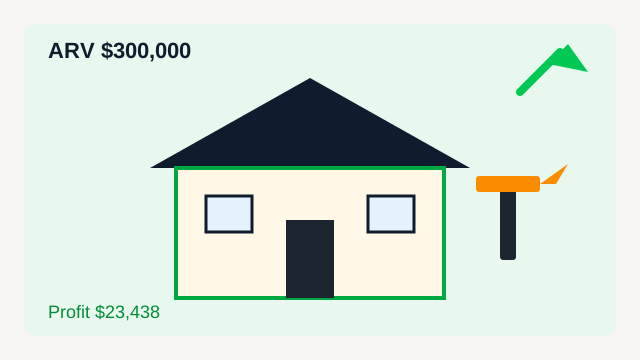
This is for anyone pricing a flip who keeps forgetting the agent, the interest, and the holding bill. It buys at $180,000, rehabs $45,000 plus 10% contingency, and sells at a $300,000 ARV. Profit is $23,437.50 on $41,062.50 of cash, which is 7.81% of ARV. The price is $15,000 over the 70% rule, and a 10% lower ARV loses $4,162.50. Last reviewed: November 2026. Illustration, not a forecast.
Last reviewed: November 2026. Illustration, not a forecast.
Fix and flip calculator
Use this fix and flip calculator to show the check you write, the check you hope to get, and how fast a late sale or a soft ARV eats the gap. This one uses hard money points and interest, a rehab contingency, holding costs, and selling costs. Educational only. Not financial advice. Example hard money terms, not offers.
How to use this calculator
- Type the purchase price and the rehab budget you would actually sign, then add a contingency you will not spend on nicer tile.
- Set the ARV from sold comps of similar houses after similar work. The profit is only as honest as that number.
- Match the hard money line to a real term sheet: percent of price, percent of rehab, rate, and points.
- Set the months, the monthly holding costs, and the selling costs. Stretch the months before you fall in love with month six.
- Read profit, cash needed, the 70% offer, and the break-even ARV. Then open the heatmap.
- Leave hard money draws off to match the full-loan profit. Turn them on to price even rehab draws, then read the overrun heatmap.
What the numbers mean
- Profit
- ARV minus the purchase, the rehab with contingency, buy closing, points, interest, holding, and selling costs. If you left one of those out, this is not your profit.
- Cash needed
- The same costs except selling, minus the loan. This is the cash the deal asks for before the sale, and selling comes out of the buyer's check.
- ROI and annualized ROI
- Profit divided by cash needed. Annualized ROI multiplies by 12 and divides by the months. Simple, not compounded, and loud because the lender holds most of the project.
- 70% rule max offer
- ARV times 0.70, minus the rehab budget before contingency. Your price can sit over it and still profit, or under it and still lose.
- Break-even ARV
- The sale price where profit is zero if the other costs stay put and selling costs stay the same percent. Miss this and the pretty ROI was a story.
- Margin
- Profit divided by ARV. A big ROI on a small cash check can still be a thin slice of the sale price.
- Hard money draws
- Off by default, so the example profit stays $23,437.50. On, interest on the rehab portion uses half that loan. Points on that portion are their own line and are not added a second time.
- Rehab overrun heatmap
- Profit at 4, 6, 9, and 12 months if the rehab budget is 0%, 10%, 25%, or 50% higher before contingency.
Worked example: $180,000 buy, $300,000 ARV
The worked example in this fix and flip calculator is one house, not a fund. Purchase $180,000. Rehab budget $45,000. Contingency 10%, so the rehab you actually fund is $49,500. ARV $300,000. Buy closing is 2% of price, $3,600. Hard money is 90% of price and 100% of the rehab with contingency, at 11% and 2 points, for 6 months. Holding is $600 a month. Selling costs are 8% of ARV. Tax on a gain is a 24% estimate.
The loan is $211,500. Points are $4,230. Interest, with the full loan out for all six months, is $11,632.50. Holding is $3,600. Selling is $24,000. Total cost is $276,562.50. Profit is $23,437.50. After the tax estimate, $17,812.50 is left. Cash needed is $41,062.50. ROI is 57.08%. The simple annualized ROI is 114.16%. Margin is 7.81% of ARV.
That ROI looks loud because the lender carries most of the project. The margin does not. $23,437.50 on a $300,000 sale is a thin cushion. The 70% rule max offer is $165,000, so this price is $15,000 over the rule. Break-even ARV is $274,524.46. You do not need a disaster. You need the appraisal, or the buyer, to miss by about 8.5%.
Move one lever at a time in the fix and flip calculator. Four months of hold makes $28,515. Twelve months makes $8,205. An ARV of $270,000 loses $4,162.50. A rehab budget of $56,250 before contingency, which is 25% higher, still profits $10,134.38, but the pretty number is gone. This fix and flip calculator heatmap is the same story in a grid: $270,000 at 4 months is $915, $270,000 at 9 months is about -$11,779, and $330,000 at 6 months is about $51,038.
Every cost in a flip
Every cost in a flip is either cash you wire before the sale or cash the closing agent keeps at the sale. This fix and flip calculator lists both, because people forget the second list and then call the first list their profit.
Purchase price is the obvious one. Rehab is the one that moves. Contingency is not a slush fund for nicer tile. It is the roof, the panel, and the plumbing the inspector did not open. The example pads $45,000 to $49,500. If you already hid padding inside the $45,000, do not add 10% again or you will talk yourself out of a fine deal. If the $45,000 is the happy bid, 10% is light.
Buy closing is a percent of price. Two percent of $180,000 is $3,600. Hard money points are a percent of the loan, $4,230 here, paid up front. Interest is not a mystery fee. It is the rate times the loan times the months, divided by 12. Holding is tax, insurance, and utilities for a vacant house. Selling costs are the agent and the seller side of the closing, modeled as 8% of whatever ARV you type. A lower sale price trims that bill and still hurts, because you lose the whole price drop and save only the commission on it.
Total cost on the example is $276,562.50, which is 92.19% of the $300,000 ARV. Profit is the other 7.81%. If you want a fix and flip calculator that flatters you, leave out interest, points, or the agent. This page will not. Add square feet in the advanced group if you want all-in cost per foot. Blank stays blank. Nothing is uploaded.
The 70% rule (and when it is too loose or too tight)
The 70% rule is a back-of-the-envelope max offer: 70% of ARV minus repairs. In this fix and flip calculator the repairs in that line are the rehab budget before contingency, so the max offer is $165,000. You are paying $180,000. The deal still shows a profit. The rule and the profit can disagree, and that disagreement is the point of running both.
The rule is too tight when selling costs are low, the work is short, and you are not borrowing at 11%. A light cosmetic chip on this page (rehab $20,000, four months, same ARV) is the shape of that deal. The rule is too loose when the house needs a long permit, the holding bill is high, or the ARV is a listing price instead of a sold comp. Heavy rehab (budget $90,000, ten months, ARV $340,000) is the shape of that risk. Run it. Do not memorize it.
A fix and flip calculator cannot see the street. It cannot see that three flips closed on the block last month or that none did. Use it to throw out a price that is silly, then use break-even ARV to see what the sale has to do. Break-even on the defaults is $274,524.46. If your comps do not clear that with room, the 70% argument is already over.
Change the ARV and the rehab in this fix and flip calculator until the max offer matches a price you can get. The score gives full points at or under the offer, and zero points at 15% above it. The $180,000 price sits between those lines.
Hard money math: points, interest, and draws
Hard money math in this fix and flip calculator is points plus interest, and the interest depends on how much of the loan is actually out. This fix and flip calculator keeps a conservative assumption: the full loan is outstanding for every month you type. Draws in real life often come out as the contractor bills, so real interest can be lower. Say that out loud before you treat the $11,632.50 as a quote. It is an example rate. Get a term sheet. The draws switch on this page is off for that example. Turn it on and rehab interest uses half the rehab loan.
The example loan is 90% of the $180,000 price plus 100% of the $49,500 rehab, which is $211,500. Two points are $4,230. Monthly interest is the loan times 11% divided by 12, about $1,938.75, times six months. Holding sits beside it at $600. One more month of delay costs that interest plus the holding bill. The stats strip shows the combined number so you can feel a slipped closing.
All cash sets both loan percents and the points to zero. You skip the financing bill and you write the purchase, the rehab, the buy closing, and the holding yourself. The sale still pays the agent. Compare the cash needed, not just the profit. A higher profit on a much bigger check can be a worse use of cash than a leveraged flip with a real cushion.
The same inputs show up on the BRRRR calculator when you plan to keep the house and refinance instead of selling. The button under the results opens that page with the purchase, the rehab including contingency, the hard money percents, the rate, the points, the months, the holding cost, and the ARV filled in. It does not change that page's rental rate. Selling instead of refinancing is the whole reason this fix and flip calculator exists.
What kills flip profits: ARV, time, and rehab overruns
What kills flip profits in this fix and flip calculator is rarely a mystery fee. It is the sale price, the calendar, or the scope. This fix and flip calculator puts those three on a heatmap and on two charts so you can see the damage before you waive an inspection.
ARV first, in this fix and flip calculator. A 10% miss, $270,000 instead of $300,000, turns $23,437.50 of profit into a $4,162.50 loss. The selling-cost bill shrinks with the price, and it is not enough to save it. The bar chart runs from 15% under to 10% over. If your comps are a range, underwrite the low end of that range, not the average of the listings.
Time next, in this fix and flip calculator. Profit is $28,515 at four months and $8,205 at twelve, with nothing else changed. The line chart draws month 2 through month 18. The heatmap crosses ARV from 85% to 110% of your number with holds of 4, 6, 9, and 12 months. $270,000 held nine months is about -$11,779. $330,000 held six months is about $51,038. The outlined cell is your current ARV column and your current month, when that month is one of those four. A second heatmap uses those same holds against a rehab overrun of 0, 10, 25, and 50 percent. At 6 months, 10% extra rehab leaves $18,116.25.
Rehab last, in this fix and flip calculator. Raising the budget 25%, to $56,250 before the 10% contingency, leaves $10,134.38. You are still ahead, and you have spent the cushion you thought was profit. Scope the work a buyer and an appraiser can see. A pretty light fixture does not raise ARV as much as a roof. If the job needs both, put both in the budget before you raise the offer.
Flip it or keep it as a rental?
Flip it or keep it, in this fix and flip calculator, is a cash question, not a personality question. Selling locks in whatever profit this fix and flip calculator shows, and then the project is over. Keeping it trades that check for rent, a new loan, and whatever is left in the deal after a refinance. Neither path is free.
Open the BRRRR calculator with the button on this page if the plan is buy, rehab, rent, refinance. Then open the SFR rental calculator for the monthly cash flow after that new loan. The rental page's example rate stays 8.18, which is the Freddie Mac PMMS 30-year rate for the week of Nov 5, 2026 (7.18%) plus 1 investment point. It is an example, not a quote. A flip that profits $23,437.50 and a rental that loses money every month are both possible on the same house.
Taxes differ. A flip is often taxed as a short-term gain or as ordinary income. A rental may recover cash through depreciation and a later sale. This page's 24% box is only the flip estimate. It is not a rental tax model. Check with a tax pro before you pick a path because the spreadsheet liked it.
If you would not want the house as a rental at the break-even ARV, be careful about "I can always keep it" as the backup plan. The backup plan needs a rent, a loan, and a holding period you can stand. Run both tools with the same rehab and the same ARV. Then decide.
Frequently asked questions
How do you calculate profit on a house flip?
This fix and flip calculator takes the sale price and subtracts the purchase, the rehab plus contingency, buy closing, points, interest, holding, and selling costs. On the example that is $300,000 minus $276,562.50, so profit is $23,437.50. After a 24% tax estimate the leftover is $17,812.50. A loss is not given a tax credit here. Educational only. Not financial advice.
What is the 70% rule in house flipping?
The 70 percent rule calculator line is 70% of ARV minus the rehab budget before contingency. Here that max offer is $165,000. The $180,000 price is $15,000 over it. It is a screen, not a law. A cheap county and a fast cosmetic job can support a higher price. A slow heavy rehab often needs a lower one.
How much cash do I need to flip a house?
Cash needed is everything you write before the sale, minus the hard money loan. Selling costs come out of the sale, not out of this check. The example needs $41,062.50: the part of the price the loan does not cover, the buy closing, the points, the interest, and six months of holding. All-cash buyers skip the loan and write a much bigger check.
How are flip profits taxed?
Many flips are short-term gains or ordinary income, not the long-term rate people quote for a stock held a year. This fix and flip calculator multiplies a positive profit by one minus the percent you type. At 24% the $23,437.50 becomes $17,812.50. That is an estimate. Check with a tax pro. A loss stays a loss in this model.
What is a good ROI on a flip?
ROI here is profit divided by cash needed. The example is 57.08%, and the simple annualized figure is 114.16% because the hold is six months. Annualized means ROI times 12 divided by months. It is not compounded. A 7.81% margin on ARV is thin. The score on these defaults is a D. A fatter margin, a price at or under the 70% offer, and a shorter hold score higher.
How long does a flip take?
The example holds for 6 months. Profit is $28,515 at 4 months, $23,437.50 at 6, $15,821.25 at 9, and $8,205 at 12. Each extra month costs the interest on the full loan plus the $600 holding bill. Draws in real life are often slower than this model, which keeps the whole loan out the entire time. Lenders and contractors set the real calendar.
What happens if I turn on hard money draws?
Off is the default, and it keeps the full loan outstanding for every month. Profit on the example stays $23,437.50. On treats the rehab loan as drawn evenly, so interest on that portion uses half the rehab loan. Points on the rehab portion are their own line and are already inside the points total, not added twice. Example terms, not a quote.
What does the rehab overrun heatmap show?
Rows are holds of 4, 6, 9, and 12 months. Columns are a rehab overrun of 0%, 10%, 25%, and 50% on the budget before contingency. Each cell is profit. A 10% overrun on the example, held 6 months, leaves $18,116.25. The ARV by months heatmap is still there too.
Educational only. Not financial advice. Example hard money terms, not offers. Taxes on flips vary, and this 24% box is a rough estimate, not a filing.