

Real estate · What the cash really costs
Cash Out Refinance Calculator
Short answer
A cash-out refinance on a rental usually caps the new loan at 75% of value (70% for 2 to 4 units), and the real cost of the cash is far higher than the note rate when you give up a cheap old loan. A $350,000 rental with $180,000 left at 3.75% can pull $75,937.50 at 75% LTV after $6,562.50 of closing costs. The new payment is $1,959.17, up $1,010.38 a month, and cash flow goes from $701.21 to -$309.17. The effective rate on the new cash is 19.39%, not the 8.18% note rate. You need about 15.97% cash-on-cash from that cash before monthly income stops falling. Example rates, not offers.
Last reviewed: November 20, 2026. Rates checked against Freddie Mac PMMS (Nov 19, 2026), Bankrate and DSCR Direct (Nov 2026); LTV and seasoning rules against the Fannie Mae Selling Guide. Illustration, not a forecast.
Cash out refinance calculator
This cash out refinance calculator is for a rental you already own. It shows the cash you would net, the new payment, cash flow before and after, and the effective rate on the cash you pulled out. The numbers are an example. Educational only. Not financial advice.
How to use this calculator
- Type the value, the balance, the current rate, and the years left. The sliders cover value, balance, LTV, the new rate, and the new term.
- Set the new loan: LTV, rate, term, and closing costs as a percent of the new loan, not of the cash you keep.
- Read the cash you would net. That figure is the hero. The conventional, FHA, and VA lines are a typical limit, not a quote.
- Compare the old payment with the new payment, and the interest left on each. Break-even months show up only when the new payment is lower.
- Check the HELOC row on the same cash-out. Some lenders leave a HELOC interest-only. This row pays the balance down over the term you set, and the refinance payment stays put.
What the numbers mean
- Net cash
- New loan, minus the old balance, minus closing costs. This is the check the refinance would actually hand you, not the loan amount on the paperwork.
- New payment
- Principal and interest on the new loan. It replaces the old payment. Taxes and insurance are not in this line, so your real bill is higher.
- Total interest
- Every principal-and-interest payment left, minus the balance. The old loan uses the years left. The new loan uses the new term. On the default, that is $93,251.98 left on the old loan and $442,801.91 on the new one.
- Break-even months
- Closing costs divided by how much the monthly payment falls. If the new payment is not lower, there is no break-even. A $6,000 closing cost and a $300 monthly savings is 20 months.
- Typical max cash
- Value times 80% for a conventional or FHA pattern, and value times 100% for a VA pattern, minus the balance you still owe, floored at zero. A typical limit, not a quote with your name on it.
- HELOC payment
- The standard amortizing payment on the cash-out (new loan minus the current balance) at the HELOC rate and term. Default is 8% and 10 years, which is $1,000.95 a month on the $82,500 cash-out. It is not the interest-only line, and it does not change the refinance result.
Worked example: $350,000 rental with a 3.75% loan
Balance $180,000, 24 years left, payment $948.79. Rent $2,600, expenses $950, so cash flow before the refinance is $701.21. NOI for the DSCR line is rent minus expenses, $1,650, which is 1.74 times the current payment.
The new loan at 75% is $262,500. Gross cash before costs is $82,500. Closing is 2.5%, $6,562.50. You walk with $75,937.50 and a $1,959.17 payment on a fresh 30-year clock at 8.18%. The payment went up $1,010.38 a month, $12,124.56 a year. Cash flow after is -$309.17. Equity left in the building is $87,500. DSCR after is 0.84. A lender who wanted 1.20 will not enjoy that sentence.
Interest over the next 60 months, charged on the start-of-month balance, is $31,478.28 if you keep the old loan and $105,015.46 if you refinance. The chart draws both balances, or both cumulative interest totals, for 10 years.
The rate that matters: what the new cash really costs
The note says 8.18%. The cash you actually receive costs 19.39% in the first year. The formula is first-year interest on the new loan, minus first-year interest you were already going to pay on the old balance, divided by net cash.
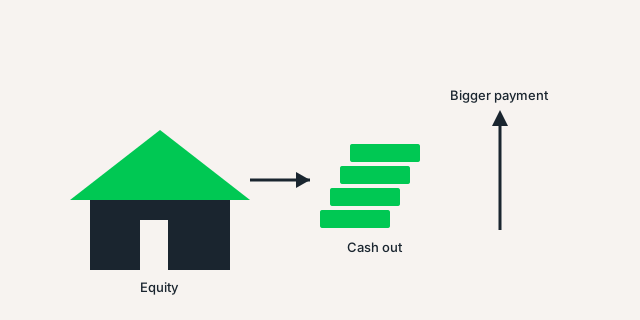
You are not just paying 8.18% on the new money. You are also giving up your 3.75% rate on the old $180,000. That give-up is why 19.39% and 8.18% can both be true. If net cash is $0 or less, the page says there is no cash at this LTV and skips the rate.
The "Higher old rate" preset keeps the $180,000 balance and changes the old loan to 7.5% with 28 years left. Current payment becomes $1,283.16. Net cash is still $75,937.50. The payment increase shrinks to $676.01. Cash flow goes from $366.84 to -$309.17. Effective rate falls to 10.50%, and the break-even return falls to 10.68%. Giving up 7.5% hurts less than giving up 3.75%. The HELOC interest-only payment stays $537.89, because the cash pulled did not change.
What are cash-out refinance rates for rentals right now?
In November 2026 a well-qualified investor can find cash-out quotes near 7.1%, and plenty will pay 7.5% to 8% once loan-level price adjustments land. Freddie Mac's 30-year average was 7.28% on November 19, and that is an owner-occupant rate with 20% down. Rentals and cash-out both add cost on top, which is why this calculator defaults to 8.18%.
| Rate source | Rate | New payment | Cash flow after | Real cost of the new cash |
|---|---|---|---|---|
| DSCR cash-out benchmark (780 FICO, 75% LTV, 1.25 DSCR), DSCR Direct week of Nov 16 | 7.124% | $1,768.33 | -$118.33 | 15.73% |
| Freddie Mac PMMS 30-year, Nov 19 (owner-occupant) | 7.28% | $1,796.06 | -$146.06 | 16.27% |
| Bankrate national average 30-year refinance APR, Nov 20 | 7.51% | $1,837.24 | -$187.24 | 17.07% |
| This calculator's default investor cash-out rate | 8.18% | $1,959.17 | -$309.17 | 19.39% |
Look at the last column. Even the best quote on the list leaves the new cash costing 15.73% in year one, because the 3.75% loan on the old $180,000 disappears either way. Shopping the rate saves real money, about $191 a month between the top and bottom rows. It does not fix a refinance that only works if the cash earns 13% or more.
Cash-out refinance rules for investment property
- Maximum LTV: 75% for a one-unit rental and 70% for two to four units on a Fannie Mae conventional loan. DSCR lenders often stop at 70% to 75% for cash-out too.
- Seasoning: at least one borrower on title for six months, and an existing first mortgage being paid off must be at least 12 months old (note date to note date).
- Bought with cash? The delayed financing exception can skip the six-month wait, but the new loan is capped at what you documented putting in, so appreciation does not count yet.
- FHA and VA: not available for a rental cash-out. Both expect you to live in the property.
- Reserves: Fannie Mae asks for six months of reserves on cash-out files with a debt-to-income ratio above 45%.
A two-unit rental worth $350,000 caps out at $245,000, not $262,500. With the same $180,000 owed and 2.5% closing, net cash drops to about $58,875. Type 70 into the LTV box and the calculator shows the smaller check.
Sources: Freddie Mac PMMS, Bankrate cash-out refinance rates, DSCR Direct rate report, week of Nov 16, 2026, Fannie Mae Selling Guide B2-1.3-03, Fannie Mae Eligibility Matrix.
Cash-out refinance vs HELOC
A HELOC for the same net cash, at 8.5% interest-only, is $537.89 a month. The old $948.79 payment stays. Together that is $1,486.68, and cash flow is $163.32 instead of -$309.17. You did not reset a 30-year clock on the whole $262,500.
Five years of HELOC interest is $32,273.44. That number is only the line on the new cash. The old loan still accrues its own interest, $31,478.28 over the same five years if you keep paying it. The refinance packs both ideas into one bill: $105,015.46 of interest and a paid-off old loan. Neither column is "free money." One of them keeps a cheap rate alive.
HELOC rates move. The 8.5% is an example, interest-only, with no draw fee and no repayment of principal. If your HELOC amortizes, the payment is higher than this line. Compare the shape of a second lien on the HELOC calculator when you want that payment spelled out on its own.
Is a cash-out refi worth it to buy another rental?
Only if the new cash earns more than the payment increase. Break-even cash-on-cash is the extra payment times 12, divided by net cash: $12,124.56 / $75,937.50 = 15.97%. The assumed 8% return produces $6,075 a year. Against $12,124.56 of new payments, you are behind $6,049.56 a year. Monthly income drops.
That 8% box is an assumption you type, not a property the calculator found. A deal that truly clears 16% cash-on-cash is a different animal from the 8% illustration. Read pay off a rental or buy more and how many rentals to retire before you count a second house you have not bought. This page does not say you should refinance. It says what the cash costs.
Free and clear rentals are a different math problem
Set the balance to $0 (the "Free and clear" preset). There is no old rate to give up. Net cash at 75% is $255,937.50. The new payment is still $1,959.17. Cash flow goes from $1,650.00 to -$309.17. The effective rate on the cash is 8.39%, close to the note, because you were not surrendering a cheap loan. Break-even cash-on-cash is 9.19%.
Redeploying that cash at 8% is $20,475 a year against $23,510.06 of new payments, a $3,035.06 shortfall. DSCR before is n/a, because there is no current loan. A HELOC on the same cash at 8.5% interest-only is $1,812.89 a month, and cash flow becomes -$162.89. Five-year interest if you keep the free-and-clear rental is $0. Five-year interest on the refinance is still $105,015.46. Pulling cash out of a paid-off rental is a choice to put a payment back on a house that did not have one.
Cash-out refinance mistakes
The expensive version of this decision is comparing only the new rate with some other loan, then spending the check. The default deal is a worked example of how that goes wrong.
- Comparing only the new rate. 8.18% looks like a normal investment quote. 19.39% is what the new dollars cost after you give up 3.75% on $180,000.
- Ignoring closing costs. $6,562.50 comes off the cash and raises the effective rate, because the denominator got smaller.
- Killing DSCR. 1.74 down to 0.84 means the rent no longer covers the payment. The next lender, or this one, may stop the conversation there.
- Spending the cash. $75,937.50 that becomes a kitchen and a truck has no cash flow to cover the $1,010.38 payment increase. The break-even math assumed you invested it.
- Resetting a 30-year clock. You had 24 years left. The new loan starts at 30. More of each payment is interest, which is why the five-year interest bill more than triples.
Frequently asked questions
How much cash can I get from a cash-out refinance on a rental?
New loan minus the old balance, minus closing costs. On a $350,000 rental at 75% LTV the new loan is $262,500. Pay off $180,000 and you have $82,500 gross. Closing at 2.5% of the new loan is $6,562.50. Net cash is $75,937.50. A lower LTV or a higher balance shrinks that. If the new loan does not cover the old balance and closing, net cash is zero or negative and there is nothing to pull.
Is a cash-out refinance a good idea in 2026?
At these example numbers the new cash costs about 19.4% a year, and cash flow goes from $701.21 to -$309.17. That is a bad trade unless the cash earns more than the 15.97% break-even return. A higher old rate changes the picture: the "Higher old rate" preset (same $180,000, 7.5%, 28 years left) drops the effective cost of the new cash to 10.50% and the break-even to 10.68%. Still an example, not a recommendation. Rates move.
What is the max LTV for an investment property cash-out refi?
On a Fannie Mae conventional loan the cap is 75% of value for a one-unit rental and 70% for two to four units. DSCR lenders usually land in the same 70% to 75% range for cash-out. At 75% the default $350,000 rental nets $75,937.50 after closing; at 70% it nets about $58,875. Your lender, credit score, and the DSCR after the new payment decide where inside that range you land.
Is cash-out refi money taxable?
Borrowed money is usually not income. That is a tax question this page does not answer, and the rules have edges (what you do with the cash, whether the loan is secured by the rental, your own facts). Ask a tax pro. The calculator also does not model whether the new interest is deductible. The disclaimer says the same thing.
Is a HELOC better than a cash-out refinance?
On the default deal, a HELOC at 8.5% interest-only on the same $75,937.50 costs $537.89 a month. You keep the $948.79 first mortgage. Combined payment is $1,486.68, and cash flow stays positive at $163.32. The cash-out refinance replaces the cheap loan and cash flow goes to -$309.17. Over five years the HELOC interest-only bill is $32,273.44, and the old loan interest still runs ($31,478.28 on the keep path). The refinance interest over those five years is $105,015.46. A HELOC rate can adjust. This comparison holds the old loan in place.
How long do I have to own a property before a cash-out refi?
For a conventional Fannie Mae loan, at least one borrower must be on title for six months, and any first mortgage being paid off must be at least 12 months old, measured note date to note date. If you bought with cash, the delayed financing exception can skip the six-month wait, but the loan is capped at the cash you documented putting in. Fresh rehab projects belong on the BRRRR calculator.
What is a typical max cash-out for conventional, FHA, and VA?
For a home you live in, conventional and FHA cash-out stop at 80% of value and VA can reach 100%. On the $350,000 example with $180,000 owed that is $100,000, $100,000, and $170,000 before closing. A rental is different. FHA and VA cash-out require owner occupancy, and conventional drops to 75% for one unit, so the same rental tops out at $82,500 before closing and $75,937.50 after.
How do break-even months work on a cash-out refinance?
Divide closing costs by the monthly payment savings, and only when the new payment is lower. Closing costs of $6,000 and a payment that falls from $2,000 to $1,700 save $300 a month, which is 20 months. On the default example the payment rises from $948.79 to $1,959.17, so break-even months stay blank.
How does an amortizing HELOC compare with this cash-out?
The amortizing row borrows the cash-out, new loan minus the current balance, which is $82,500 on the default. At 8% for 10 years the payment is $1,000.95 and the interest over those 10 years is $37,614.32. The refinance payment stays $1,959.17, and interest over the 30-year term is $442,801.91. The old loan still has $93,251.98 of interest left over 24 years. Some lenders bill a HELOC interest-only. This row is a fully amortizing illustration, and it does not change the refinance result. The 8.5% interest-only line above is a separate comparison on net cash.
What are cash-out refinance rates for investment property today?
In November 2026, DSCR cash-out benchmarks for strong borrowers sit near 7.12%, the Bankrate 30-year refinance APR average is 7.51%, and Freddie Mac's owner-occupant average is 7.28%. Expect a rental cash-out to price above the owner-occupant average. On the default deal, every quote from 7.12% to 8.18% leaves the new cash costing 15.7% to 19.4% in year one.
More free loan and debt tools: 15 vs 30 year mortgage, DSCR loan, HELOC, debt snowball, rent vs buy. See the full loans and debt list.
Educational only. Not financial advice. Lenders set LTV limits, seasoning rules, rates, and fees, and giving up a cheap loan is the expensive part. Example rates, not offers. Ask a tax pro about interest deductibility.