

Real estate · Cash left in the deal
BRRRR Calculator
Short answer
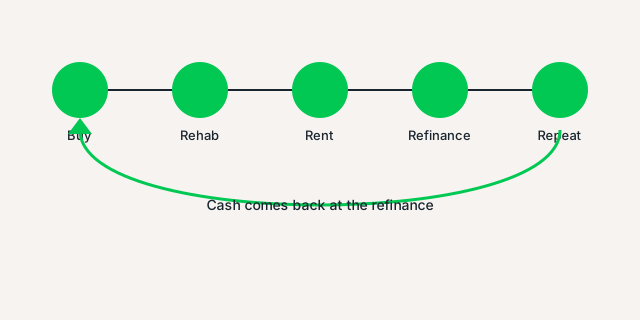
This tells you how much of your cash a BRRRR actually gives back, for anyone who has heard that all the money comes out and wants the check. Buy at $110,000, rehab $35,000, and refinance at 75% of a $200,000 ARV. You put $27,450 in, get $11,500 back, and leave $15,950 in the deal. Cash flow after the new loan is $86.97 a month (6.54% cash-on-cash). The 70% rule max offer is $105,000, so the purchase fails that screen by $5,000, and the price that would leave $0 of cash in is $95,058.55. Example rates, not offers.
Last reviewed: November 20, 2026 by The Cash Flow Scout. Refinance rules checked against the Fannie Mae Selling Guide and 2026 DSCR lender guidelines; rates against Freddie Mac PMMS (7.28% on Nov 19, 2026). Illustration, not a forecast.
BRRRR calculator
Follow the cash from the purchase through rehab, holding, and the refinance. The result that matters is cash left in the deal, then the cash flow that loan still has to support. The figures below are a made-up example. Educational only. Not financial advice. Selling instead of refinancing? Use the fix and flip calculator.
How to use this calculator
- Type the purchase price, the rehab, the closing costs, and the after-repair value you can defend with sold comps.
- Set the refinance loan, the rate, the rent, and the expenses. Leave the extra hard-money box off unless you want those costs added on purpose.
- Read cash left in first. Then cash back, monthly cash flow, and capital recycled.
- Check the 75% of ARV line and the 70% rule. Pass or fail is written in words, not only in a color.
- Open What if, the ARV and rehab grid, and the 10-year cash flow before you raise the offer.
What the numbers mean
- Cash left in
- Cash in minus cash back. If this is still a pile of money, the refinance did not free you for the next house.
- Cash back
- The new loan, minus refinance closing, minus the purchase hard-money payoff. Most of the new loan retires the old one.
- Capital recycled
- Cash back divided by cash in. With the extra module off, both figures use the purchase-loan math only.
- 75% ARV room
- 75% of ARV minus purchase, rehab, closing, and holding. Extra points and interest join only when the module is on.
- Monthly cash flow
- Rent minus expenses minus the new payment. This is what shows up after the refinance party is over.
- Year-1 cash flow
- Monthly cash flow times 12 when rent growth and expense growth are both 0. Move those rates and year 1 is no longer that simple.
Worked example: $110,000 buy, $200,000 ARV
Hard money covers 90% of the $110,000 price and 100% of the $35,000 rehab, so the loan is $134,000. You still write a $11,000 down-payment check and $4,000 of buy closing. Points are 2% ($2,680). Six months of 11% interest on the full draw is $7,370. Holding is $400 times 6, or $2,400. Cash in is $27,450.
All-in cost, purchase plus rehab plus those carrying costs, is $161,450, or 80.73% of the $200,000 ARV. The refinance is $150,000. After $4,500 of refinance closing and paying off the $134,000 hard-money loan, $11,500 comes back. Cash left in is $15,950. Equity on paper is $50,000, which you cannot spend.
Rent is $1,950. Vacancy, management, repairs, and capex take 23% ($448.50). Tax and insurance are $295. Operating expenses are $743.50. Principal and interest on the new loan is $1,119.53. Cash flow is $86.97. NOI is $14,478 a year, a 7.24% cap rate on ARV. NOI DSCR is 1.08. A lender-style ratio that uses rent over principal, interest, tax, and insurance is 1.38. Same building, two different coverage stories.
How the BRRRR calculator works
Each line is cash you write, or cash the refinance sends back. Nothing is annualized until the cash-on-cash line. Interest is not compounded inside the holding period. It is the hard-money rate times the full loan times the months, divided by 12.
- Down payment cash is the part of the price hard money does not cover. At 90%, that is $11,000.
- Rehab cash is the part of rehab you pay. At 100% financed, that is $0. The rehab still counts in all-in cost.
- Buy closing is cash at purchase, separate from refinance closing.
- Points are a percent of the hard-money loan, paid up front.
- Hard-money interest uses the full draw from day one. Real draws arrive in stages, so this number runs a bit high on purpose.
- Holding is your monthly carry (the default $400) times the months until refinance.
- Cash back is new loan minus refinance closing minus the hard-money payoff. If that is larger than cash in, cash left in goes to zero or below and the cash-on-cash label becomes infinite only when cash flow is also positive.
How much cash do you get back at the refinance?
In the example, $11,500. That is not 75% of ARV. It is 75% of ARV, minus closing, minus the loan you already owe. Most of the new mortgage is spent retiring the hard-money note.
Percent recovered is cash back divided by cash in: 41.89%. The other 58% is still your money, sitting in the house as cash left in. Repeat only works when that leftover is small enough that you can fund the next purchase. A $15,950 remainder means the next deal needs a new pile of cash, not just the refinance check.
If cash left in is $0 or less and cash flow is positive, the calculator says "Infinite: all your cash came back." Infinite is a label for a zero denominator, not a promise. If the cash came back and cash flow is not positive, it says so in plain text instead of printing a fake percent.
The refinance is the whole game
ARV sets the loan. LTV sets how much of that ARV a lender will advance. The rate sets the payment. The months set how long you carry hard money. Move any one of them and the "cash back" story changes without the purchase price moving.
Drop ARV 7.5%, to $185,000. Cash back falls to $587.50. Cash left in jumps to $26,862.50. Cash flow actually rises to $170.94, because the new loan is smaller. You kept more cash flow by getting almost none of your cash back. That is not a full BRRRR.
Add 1 point to the refinance rate (8.18% to 9.18%). Cash back stays $11,500 and cash left in stays $15,950. Cash flow flips to -$19.91. The rate did not touch the check at the closing table. It touches every month after.
Add 3 months, nine instead of six. Cash in becomes $32,335 because interest and holding keep running. Cash back is still $11,500. Cash left in is $20,835. Cash flow stays $86.97. Seasoning is a cash cost even when the appraisal holds. Example rate: an investment refinance is often priced above a primary-home quote. The 8.18% here is an example, not an offer.
How long do you have to wait to refinance a BRRRR in 2026?
Usually six months from purchase, and the lender type decides the rest. Most DSCR lenders want 6 months of ownership before a cash-out on the appraised value. Fannie Mae also wants 6 months on title, and it adds a catch: the mortgage being paid off must be at least 12 months old. A hard-money note retired at month six fails that test.
| Refinance path | Wait before cash-out | Max loan | What it means for a BRRRR |
|---|---|---|---|
| Conventional (Fannie Mae) | 6 months on title, and the loan being paid off at least 12 months old | 75% LTV on a 1-unit rental, 70% on 2 to 4 units | Fits a cash purchase or a 12-month hold. A 6-month hard-money payoff usually does not qualify. |
| Fannie Mae delayed financing | None, within 6 months of an all-cash purchase | Documented purchase cost plus closing costs, not ARV | Returns your purchase cash. The rehab lift stays in the house until a later refinance. |
| DSCR lender, 6-month program | 6 months from acquisition (the most common rule) | About 75% of appraised value | The usual BRRRR exit. Priced above owner-occupied rates. |
| DSCR lender, 3-month program | 3 months | Lesser of 75% LTV or purchase plus documented rehab | Faster, but the loan is sized on cost, so the check is smaller. |
Here is the trade on the default deal. A 3-month lender caps the loan at cost: $110,000 plus $35,000 is $145,000, which sits under 75% of ARV. After 3% closing ($4,350) and the $134,000 payoff, $6,650 comes back instead of $11,500. But you skip three months of hard-money interest and holding, about $4,885, so cash in drops to $22,565. Cash left in lands at $15,915, almost exactly the $15,950 of the 6-month plan, and the smaller loan lifts cash flow to about $124 a month. Waiting is not free. Neither is hurrying.
Rates are the other half. Freddie Mac's survey had the average 30-year fixed at 7.28% on November 19, 2026, and that is an owner-occupied number. Investor cash-out loans usually price higher, which is why the refinance default here is 8.18%. If you somehow landed 7.28%, the payment on $150,000 would be $1,026.32 and cash flow about $180. Plan on the higher rate and treat anything better as a gift. Before you choose a path, run the same refinance through the cash-out refinance calculator and check coverage in the DSCR loan calculator.
Sources: Fannie Mae Selling Guide B2-1.3-03, Freddie Mac PMMS, DSCR Authority seasoning guide. Lender rules change; confirm with the lender you plan to use before you buy.
Max purchase price for a full BRRRR
A full BRRRR, in this calculator, means cash left in is $0 or less. Holding every other input at the defaults, that purchase price is $95,058.55. The search runs from $0 to twice the ARV. The $110,000 price in the example is $14,941.45 above that line.
The 70% rule is a different screen: 70% of ARV minus rehab, here $105,000. The example fails it by $5,000. Passing the 70% rule does not mean cash left in is zero, and missing it does not mean the cash flow is negative. Read both lines. The text says Pass or Fail so the color of the row is not the only signal.
All-in at or under 75% of ARV is the third screen. $161,450 is 80.73% of $200,000, so that one fails too. Three different "is this too expensive" tests, three fails, and the building still cash flows $86.97. The cash flow is real. The cash you cannot pull back out is also real.
BRRRR mistakes that strand your cash
The calculator believes the ARV, the rehab bid, the rate, and the rent you type. The usual way a BRRRR strands cash is that one of those four moves after you are already in the deal.
- Rehab overrun. Every extra rehab dollar you do not finance comes straight out of cash left in. The 100% rehab draw in the example is a hopeful input.
- Appraisal comes in low. The 7.5% ARV cut above turns an $11,500 check into $587.50. The lender lends on their value, not the one in the spreadsheet.
- Rates rise during rehab. One extra point wipes the $86.97 cash flow and replaces it with a $19.91 monthly loss. You still left $15,950 in.
- Thin cash flow after the refinance. $86.97 is one repair away from zero. NOI DSCR of 1.08 will also bother plenty of lenders. Run the stabilized rent through the DSCR loan calculator and read the BRRRR cash flow guide before you repeat the loop.
Frequently asked questions
What is a good BRRRR deal?
On this example, not the postcard version. You put in $27,450 and get $11,500 back, so $15,950 stays in the house. Cash flow after the refinance is $86.97 a month, cash-on-cash is 6.54%, and NOI DSCR is 1.08, under the 1.20 line used here. A full BRRRR would leave $0 or less in the deal. This purchase price misses that by a wide gap. The max price for $0 left in is $95,058.55.
How much cash can you pull out in a BRRRR refinance?
Cash back is the new loan, minus refinance closing costs, minus the hard-money balance you still owe. At 75% of a $200,000 ARV the new loan is $150,000. Closing at 3% is $4,500. The hard-money loan is $134,000. Cash back is $11,500, which is 41.89% of the $27,450 you put in. A lower appraisal or a lower LTV shrinks that check fast, which is why the ARV is the whole game.
What is the 70% rule?
A common screen: do not pay more than 70% of ARV minus repairs. Here that is $105,000. The $110,000 purchase fails by $5,000. It is a screen, not a law. Cash left in, and the cash flow after the refinance, tell you whether your money is actually stuck.
How long before you can refinance?
This calculator uses the months you type. The default is 6, and holding costs are $400 a month, so $2,400. Lenders set their own seasoning rules, and many want longer than six months. Stretch the same deal to 9 months and cash in rises to $32,335. Cash left in rises to $20,835. Cash flow stays $86.97 because the refinance terms did not change. In 2026 most DSCR lenders want 6 months from purchase, a few allow 3 months but size the loan on cost, and Fannie Mae also wants the loan being paid off to be at least 12 months old.
Can you use a conventional loan for a BRRRR refinance?
Sometimes, but rarely at month six. Fannie Mae allows cash-out on an investment property at up to 75% LTV for one unit and 70% for two to four units, after 6 months on title. It also requires any first mortgage being paid off to be at least 12 months old, so a 6-month hard-money payoff usually goes to a DSCR or portfolio lender instead.
Can you BRRRR with all cash?
Yes. Switch purchase financing to all cash and the hard-money loan, points, and hard-money interest all drop to $0. You still pay the purchase price, the rehab, buy closing, and holding costs. On these other defaults that is $151,400 in, $145,500 back, and $5,900 left in the deal. Cash flow is still $86.97. You skipped the hard-money bill. You did not skip the need for a refinance that covers what you spent.
What if the BRRRR doesn't cash flow after the refi?
Then the cash you left in is earning a monthly loss, not a return. Raise the refinance rate by 1 point, to 9.18%, and this deal's cash flow goes from $86.97 to -$19.91. Cash back stays $11,500 because the loan size did not change. Thin cash flow is the part that shows up every month after the refinance party is over. Open the same rent and loan in the SFR rental calculator before you call it a win.
What does the extra hard-money module add?
It is off by default, so this example still leaves $15,950 in the deal. Turn it on and the page adds a loan of 70% of purchase plus rehab, which is $101,500 here, plus 2 points ($2,030) and 12% interest for 6 months ($6,090). Those points and interest are added to cash in. The purchase loan above the module does not change.
What is capital recycled, and what is the 75% of ARV check?
Capital recycled is cash back divided by cash in. On the example that is $11,500 divided by $27,450, or 41.89%. The 75% check adds purchase, rehab, buy closing, and holding. Here that is $151,400 against $150,000, so the room is -$1,400 and the check fails. It is not the same total as the 80.73% all-in line, which also includes the purchase-loan points and interest.
What does the What if table change?
Three cases, one at a time: appraisal down 10% (cash left in $30,500), rehab up 20% (cash left in $23,475), and rent down 10% (cash left in stays $15,950 and cash flow falls to about -$63.18). The base row stays on your current inputs, so you can see which scare actually moves the cash.
How does the 10-year cash flow grow?
Year 1 uses this year's rent, expenses, and payment. Rent growth and expense growth start at 0%, so year 1 equals the monthly cash flow times 12, about $1,043.68 on the example. The equity table is separate and still uses the 3% rent and appreciation boxes.
More free loan and debt tools: 15 vs 30 year mortgage, DSCR loan, HELOC, debt snowball, rent vs buy, cash-out refinance. See the full loans and debt list.
Educational only. Not financial advice. ARV, rehab costs, refinance terms, and seasoning rules vary, and a lender can ignore the number you liked. Example rates, not offers.