

Financial independence · when saving can stop
Coast FIRE Calculator
Short answer
Coast FIRE is the point where the money you already have invested can grow to your retirement number on its own, so you only work to cover today's bills. Your Coast FIRE number is your FIRE number divided by (1 + real return) for every year until retirement. Example: you need $359,062 invested today to coast to $1.25 million by 60. Keep saving $1,500 a month and you coast at 52.5. Add $12,000 a year of rental or dividend cash flow in retirement and you coast in 8 years 5 months instead of 17 years 6 months. The gap today is $209,062. That gap is why stopping now is not the same as coasting.
Last reviewed: November 19, 2026. Illustration, not a forecast.
Coast FIRE calculator
This Coast FIRE calculator answers when you can stop new saving and still reach the number by a chosen age. It is for someone who will keep working to pay the bills. It asks how much must be invested today so growth alone reaches your FIRE number, and when continued deposits first put you on that path. The honest catch: the return has to show up. Educational only. Not financial advice.
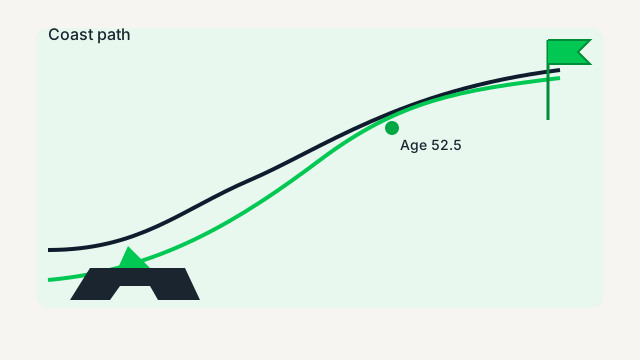
Coast age is 52.50 on the example. That is when new contributions can stop. From that age the balance grows to the FIRE number with no more deposits.
Educational only. Not financial advice. The lines are an illustration, not a forecast.
How to use this calculator
- Set your age and the age when the portfolio should carry the spending.
- Enter annual spending and a withdrawal rate. 4% is the starting example.
- Pick a real return. 5% is the example. Move it before you trust the age.
- Enter what is invested now, and the monthly deposit you will make until you coast.
- Add retirement cash flow only if it keeps paying and you are not also selling that asset.
- Read the coast number, the gap, and the coast age. Open the full FIRE timeline if you still want a savings date.
What the numbers mean
- FIRE number
- Spending minus retirement cash flow, divided by the withdrawal rate. At $50,000 and 4% it is $1,250,000.
- Coast number today
- The FIRE number pulled back to today. Hit this balance and new savings are optional in the model.
- Coast age
- The age when continued deposits first put you on that path. The default is 52.50.
- Barista gap
- Monthly spending that work still has to cover after you coast, until the retirement age.
- Stop-now balance
- What today\'s investments grow to if contributions drop to zero. On the example that is $522,193.57 at 60.
Worked example: age 35, $150,000 invested
The example is a 35-year-old who wants age 60 to be the handoff. Spending is $50,000. The withdrawal rate is 4%. The real return is 5%. They have $150,000 invested and can add $1,500 a month. Retirement cash flow starts at $0.
The FIRE number is $1,250,000. The coast number today is $359,062.25, so the gap is $209,062.25 and progress is 41.78%. If they stop contributing this month, the balance at 60 is $522,193.57. That is not enough. Keep the $1,500 and the coast month is 210, which is 17 years 6 months, age 52.50, balance $861,204.39. After that, the model grows the balance with no new deposits and work covers the $4,166.67 monthly spending.
Change one thing at a time. $1,000 a month never coasts before 60. Retiring at 65 instead of 60 cuts the coast number to $279,783.24 and the coast month to 108 (9 years). A 7% real return cuts the coast number to $218,324.66 and the month to 54. Age 25 with $40,000 invested, and the other boxes left on the example, has a coast number of $218,008.61 and coasts at month 165 (13 years 9 months). Same formula, different clock.
What is Coast FIRE?
Coast FIRE is the point where compounding can finish the job. You are not financially independent yet. You still work. You just do not have to save another dollar for the later portfolio, if the return shows up and the spending stays honest. This calculator is built for that one checkpoint.
People mix it up with quitting. Quitting is a spending problem you solve with a paycheck, a smaller life, or cash flow that arrives without the job. Coasting is a savings problem you stop feeding. The job remains the thing that buys groceries until the retirement age on the form. If the job is miserable, coasting does not fix Tuesday. It only stops the guilt about a missed brokerage deposit.
A useful coast number is specific. "I invest" is not a number. $359,062.25 at these inputs is a number. It moves when spending, the withdrawal rate, the real return, or the retirement age moves. That is why the calculator puts those on sliders instead of hiding them in a footnote. Rerun it after any spending change, because the coast age is only as honest as that box.
How to calculate your Coast FIRE number
Start with the FIRE number. Spending the portfolio must replace, divided by the withdrawal rate, is the pile you want on the retirement birthday. $50,000 divided by 0.04 is $1,250,000. If retirement cash flow already covers part of spending, subtract that first. Don't subtract cash flow you only hope to have.
Count the months. Age 35 to age 60 is 25 years, 300 months. Turn the real annual return into a monthly rate by dividing by 12. Five percent becomes 0.05/12. The coast number today is the FIRE number divided by (1 + monthly rate) raised to the month count. That is compound discounting, the reverse of a future-value problem. You are asking what present balance grows into the target.
The coast month is a walk, not a closed formula, because deposits stop being useful the moment the balance is already big enough to finish alone. Each month the calculator grows the balance, adds the contribution, and checks it against the required balance for the months still left. The first month that passes is the coast month. Month 0 means you can coast today. No passing month means "not before your retirement age at this contribution." The heatmap labels that case Never.
Coast FIRE vs Barista FIRE
Coast FIRE keeps full spending on the job and takes new saving off the table. Barista FIRE keeps a smaller job and lets that pay reduce the portfolio. The barista income box is that pay, monthly. It starts at $0, so the coast number stays $359,062.25. The barista gap card is still full spending, $50,000 a year or $4,166.67 a month, until you type a paycheck.
$1,000 a month is $12,000 a year. That is the same portfolio cut as $12,000 of retirement cash flow: coast number $272,887.31 and coast month 101. $500 a month cuts spending by $6,000, so the FIRE number is $1,100,000 and the coast number today is $315,974.78, month 149, age 47.42. Leave the box at $0 and nothing else moves. Read the plain-language version in coast and barista FIRE with a cash flow bridge before you pick a label for a spreadsheet.
Healthcare sits on the spending line either way. A coast plan that forgets insurance before Medicare is a plan that works only on paper. Put the premium in annual spending and run it again. The coast age will move, and that movement is the point. Nobody else is going to invent that premium for you.
How cash flow makes coasting easier
Retirement cash flow lowers the pile the portfolio has to reach. $12,000 a year means the portfolio covers $38,000, not $50,000. At 4% the FIRE number falls from $1,250,000 to $950,000. The calculator then puts the coast number at $272,887.31 and the coast month at 101, which is 8 years 5 months, instead of 17 years 6 months. Same saver, same $1,500 deposit, smaller target.
The cash flow has to survive retirement. A rental counted in invested now and again in the cash-flow box is double counting. Dividends you will spend belong in the cash-flow box only if you are not also spending the shares. A business you plan to sell is a lump sum, so it belongs in invested now. The calculator can't see your lease or your tenant; it only subtracts the yearly figure you type. Use a number you could actually deposit, not gross rent.
Two neighboring tools stay in their lanes. The financial freedom calculator dates the month streams cover a goal. The retirement calculator compares a cash-flow retirement with a withdrawal retirement. This page only asks when saving can stop.
Risks of coasting too early
The calculator assumes the real return arrives every month. Markets don't send a check on that schedule. A bad decade early in the coast years can leave you short at 60 even if the long-run average looks fine, and the same timing problem bites again once withdrawals start. A 1966 retiree pulling 4% from a 60/40 portfolio ran dry in year 25; the sequence of returns risk calculator replays that and every other start year since 1928. Returns are not guaranteed. If the gap reopens, the honest move is to start saving again, not to argue with the spreadsheet.
Spending grows in ways a real-return box does not capture if you left those costs out. Kids, a parent, a move, a higher insurance premium. The withdrawal rate is a rule of thumb from long studies, not a contract. Morningstar's 2026 research puts the safe starting rate for a 30-year retirement at 3.9%, a hair under the classic 4%. A retirement that starts at 60 and runs for 30 years is a different problem from one that starts at 45. Lower the rate when the horizon is long, and watch the coast number jump.
Taxes are outside this model. A traditional account is not all spendable. A taxable account throws off dividends you may owe tax on before you wanted the income. Rental cash flow has vacancies, repairs, and debt service. The score is a weighted checklist of the inputs you typed. It is not a judgment of your life, and it is not advice. If you see a coast age you love, drop the return a point before you cut the deposit.
Frequently asked questions
What is Coast FIRE?
Coast FIRE means the investments you already have can grow to your FIRE number by a retirement age you pick, even if you stop adding new savings. In the default example the saver is 35, spends $50,000, and wants to retire at 60. The FIRE number is $1,250,000. The coast number today is $359,062.25. They have $150,000, so they are 41.78% there and still $209,062.25 short of coasting with no new deposits.
How do I calculate my Coast FIRE number?
Divide the spending your portfolio still has to cover by the withdrawal rate. That is the FIRE number. Then discount it back to today at your real monthly return for every month until retirement. The math is $1,250,000 / (1 + 0.05/12)^300, which is $359,062.25. Keeping the $1,500 monthly deposit, the balance clears the required line at month 210 (17 years 6 months), age 52.50, with $861,204.39 in the account.
What return should I use?
Use a real return if spending is in today's dollars. The default is 5% after inflation, an example, not a forecast. At 7% the same saver's coast number falls to $218,324.66 and the coast month is 54 (4 years 6 months). A lower return does the opposite. Do not type a nominal return next to today's spending or the date will look too soon.
What is the difference between Coast FIRE and Barista FIRE?
Coast FIRE is about stopping new savings while a job still pays the bills. Barista FIRE is about a smaller paycheck that also shrinks the portfolio you need. The barista gap card stays full spending, $50,000 a year or $4,166.67 a month, while barista income is $0. The guide on coast and barista FIRE with cash flow separates the labels.
What is coast age?
Coast age is when you can stop contributing and the balance can still grow to the FIRE number with no more contributions after that age. On the example it is 52.50, month 210, with $861,204.39 in the account. If the contribution never clears the line before retirement, coast age is blank.
What does the barista income box do?
It is optional monthly pay that reduces the spending the portfolio must cover. At $0, the default, the coast number stays $359,062.25 and the share link leaves the barista key off. $500 a month is $6,000 a year, so the portfolio covers $44,000. At 4% the FIRE number is $1,100,000. Discounted 300 months at 5% real, the coast number today is $315,974.78. The coast month is 149, age 47.42.
Can I stop saving once I reach Coast FIRE?
Only for new investments, and only if the coast test still passes when you stop. The default gap is $209,062.25, so stopping today leaves $522,193.57 at 60, well under $1,250,000. After month 210 the model says new deposits are optional and work covers spending. A bad decade can push that date back. Returns are not guaranteed.
Does rental income help me coast sooner?
Yes, when the cash flow keeps paying in retirement and you do not also count the same property as cash you will sell. In the example, $12,000 a year drops the coast number from $359,062.25 to $272,887.31. The $1,500 monthly deposit then coasts at month 101 (8 years 5 months) instead of month 210. Put rent you plan to sell inside invested now, not in the cash-flow box.
Educational only. Not financial advice. Returns are not guaranteed. A bad decade can push the coast date back, and the honest move is to start saving again.