

Crypto · Free calculator
Crypto Real Yield Calculator
Short answer
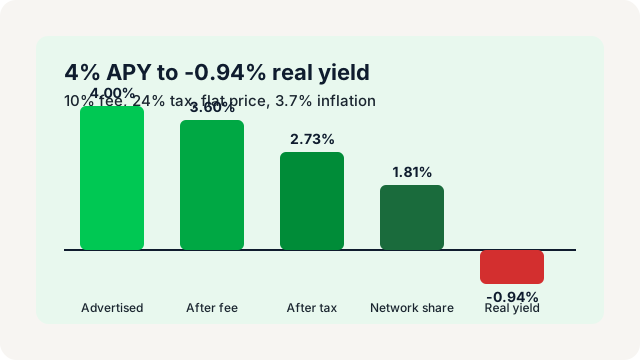
Your real crypto yield is the advertised APY after the platform's cut, the tax on each reward, the coin's price move, and inflation. A 4% APY with a 10% commission and a 24% tax keeps 2.73%. If the price stays flat while prices at the store rise 3.7%, that stake loses 0.94% of its buying power every year. Last reviewed: November 2026. Illustration, not a forecast.
Real yield calculator
Type the rate you were offered and the calculator walks it down, one step at a time, to what it does for your grocery budget. You type every number. There's no live price feed and no coin name in the defaults. Educational only. Not financial or tax advice.
How to use this calculator
- Type the dollars and the APY you were shown. Don't round it up.
- Set the commission your validator or exchange keeps, then your tax bracket.
- Look up how fast your token's supply grows and type it in.
- Pick a price path. Try zero first, then a bad year, then a good one.
- Read the real yield and the break-even price rise before you call the rewards income.
- Copy the link or download the CSV if you want to compare two offers.
What the numbers mean
- After-tax coin yield
- How fast your coin balance grows once the fee and the tax are gone. 4% becomes 2.73% on the defaults.
- Network share yield
- Your coin yield measured against the whole supply. 2.73% against 0.9% new supply is 1.81%.
- Real yield
- The after-tax yield with the price path, adjusted for inflation. That's the change in what your stake can buy.
- Price rise to break even
- The yearly price gain the coin needs before the stake just keeps pace with prices at the store. 0.95% on the defaults.
Worked example: 4% APY on $10,000
Say an exchange shows you a 4% APY and you put in $10,000. It keeps 10% of the rewards, so you're really earning 3.60%. You're in the 24% bracket, and the IRS treats each reward as income the moment it lands. Sell a quarter of every reward to cover that bill and your coins grow at 2.73% a year.
Now hold the price flat for three years. The stake ends at $10,840.08. That looks fine until you notice you paid $265.29 in tax and $120.64 in commission to get there. Inflation at 3.7% means that $10,840 buys what $9,720.67 buys today. You worked a stake for three years and lost about $279 of purchasing power.
A plain savings account at 3.8% isn't a hero either. After the same 24% tax it nets 2.89%, a real yield of -0.78%. The stake trails it by about a sixth of a point while carrying every crypto risk on top. If the coin rises 10% a year, the real yield jumps to 8.97% and the stake is worth $12,938 in today's dollars. If it falls 20% a year, you're at $4,977. The price decides almost everything. The yield is the small print.
Two meanings of real yield
Crypto people use "real yield" two ways, and it's worth knowing which one a pitch means. The first is the one this page measures: what's left after fees, tax, price, and inflation. Economists would call it the inflation-adjusted return, and it's the only number your landlord cares about.
The second is about where rewards come from. A protocol that pays you from trading fees or loan interest has "real yield." One that pays you in freshly printed tokens doesn't. That second meaning matters because printed rewards dilute every holder. The network share line in the calculator is how you check it.
Token inflation and your slice of the network
Most staking rewards are new tokens. On Ethereum in November 2026, validators earn about 2.6% a year before fees, while net supply grows roughly 0.9% because very little ETH is burned when gas fees are low. So a staker's share of all ETH grows by about 1.7 points a year, and anyone who doesn't stake gets diluted.
See the same math on a live network in Is Ethereum staking worth it?, which sets current staking rates against a year when ETH fell about 40%.
High-APY tokens often do the same trick louder. Click the 15% APY chip. The token mints 12% new supply a year, so after a 5% fee and 24% tax your slice of the network shrinks by 1.19% a year. If the price falls only by the amount of the dilution, about 10.7% a year, the real yield is -4.70%. A big APY paid in a currency the network is printing quickly is mostly a rounding exercise.
Taxes on staking rewards
In the US, Revenue Ruling 2023-14 says staking rewards count as gross income in the year you gain control of them, at their fair market value that day. When you sell later, you have a separate capital gain or loss from that value. The awkward part is timing. If a coin drops after you receive it, you still owe tax on the higher number.
That's why the tool assumes you sell enough of each reward to cover the bill. It's the conservative way to keep the tax paid in dollars from coming out of your paycheck. Brokers started sending Form 1099-DA for 2025 sales, so the IRS sees more of this than it used to. Keep your own records anyway. Rules differ by country and change often. Ask a tax pro. Not advice.
Which inflation number to use
The default is 3.7%, the September 2026 year-over-year change in CPI-U. That's the newest official 12-month figure. The October report on November 10 showed prices up 0.4% for the month, but BLS couldn't publish a yearly rate because it never collected October 2025 prices during the government shutdown. If your rent, insurance, and gas are rising faster than the headline, type your own number. Your inflation is the one that matters.
Real yield FAQ
What is real yield in crypto?
Real yield is what a staking or rewards rate adds to your buying power after everything that eats it. On this crypto real yield calculator, a 4% APY with a 10% commission is 3.60%. A 24% tax on each reward drops it to 2.73%. With a flat coin price and 3.7% inflation, the real yield is -0.94% a year. Some people also use the term for rewards paid from fees instead of new tokens. Both meanings are on this page.
How do you calculate real yield?
Take the after-tax coin yield, multiply by one plus the yearly price change, then divide by one plus inflation and subtract one. At 2.73% after tax, a flat price, and 3.7% CPI, that is 1.0273 divided by 1.037, minus one, or -0.94%. The calculator does it monthly so restaked rewards compound.
Does token inflation reduce my staking yield?
It reduces your slice of the network. If a token pays you 2.73% after tax while total supply grows 0.9%, your share grows only about 1.81% a year. A token that pays 15% while minting 12% new supply leaves you with a smaller slice after tax, even though your balance went up.
Are staking rewards taxed when I receive them?
In the US, the IRS said in Revenue Ruling 2023-14 that staking rewards are income in the year you gain control of them, valued at that moment. Selling later is a separate gain or loss. This tool assumes you sell enough of each reward to cover the tax. Check the rules where you live. Not tax advice.
What inflation rate should I use?
The default is 3.7%, the September 2026 year-over-year CPI-U from the Bureau of Labor Statistics. BLS did not publish a 12-month rate for October 2026 because October 2025 prices were never collected during the shutdown. Type your own number if your costs run hotter or cooler.
Is a positive real yield a good investment?
Not by itself. The yield math assumes the coin, the validator, and the platform all survive. A price drop of 20% a year turns the same stake into a -20.75% real yield. Treat the grade as a sanity check on the rate, not a verdict on the coin. Nothing here is a promise.
Educational only. Not financial or tax advice. Crypto is volatile, staking has lockup and slashing risk, and rates change. Example rates, not offers.