

Loans · The cheap payment that grows up
HELOC Payment Calculator
Short answer
The average HELOC rate was 7.47% on November 18, 2026 (Bankrate), with prime at 7.00%. At that rate a $50,000 draw costs $311.25 a month interest-only and $401.88 once repayment starts. The calculator below starts at a more cautious 8.5%: a $50,000 draw at 8.5% on a $450,000 home is $354.17 a month while the line is interest-only. At month 121 the payment becomes $433.91 if you paid only the minimum. Over 30 years that path costs $96,638.79 in interest. Pay it like a 10-year loan ($619.93 a month) and interest falls to $24,391.41. This HELOC payment calculator is for a homeowner who wants the payment jump, the max line, and a rate shock before signing. The caveat: the rate is variable, and the house is the collateral.
Last reviewed: November 2026. Illustration, not a forecast.
HELOC payment calculator
It answers what the line costs this month, what it costs after the draw ends, and whether that jump still fits the household. A homeowner weighing a draw, not a shopper collecting teaser rates, is who this is for. The caveat is blunt: the rate can move, and the house secures the debt. Educational only. Not financial advice.
Rate stress
| Rate path | Draw payment | Repayment payment | Lifetime interest |
|---|
| Period | Rate | Payments | Interest | Principal | Extra | Ending balance |
|---|
The rate can move. The payment jumps when the draw ends. A lender can freeze or cut the line when home values fall. The house is the collateral. Borrowing against it to invest makes a bad year worse, because the loss and the payment show up together. Read the HELOC down-payment guide before you draw for a rental.
How to use this HELOC payment calculator
- Enter the home value, the first mortgage, and the CLTV cap. The max line is the value times that cap, minus the first mortgage, and it cannot fall below zero.
- Enter the amount you would actually draw. The payment uses that draw. It does not quietly switch over to the max line.
- Set the rate, the draw years, and the repayment years. Twenty years is the example repayment term already sitting on the page.
- Read the draw payment, then the repayment payment. The gap between those two is the payment shock.
- Read the rate table. It prices the same balance at your rate and at 1, 2, and 3 points higher, so the teaser month is not the whole story.
- Copy the link, download the CSV, or print the page. The email box sits outside the calculator form.
What the numbers mean
- Draw payment
- The check while the line is open. With interest-only on, that is the balance times the rate divided by 12, plus any extra principal you typed.
- Repayment payment
- The amortizing payment after the draw period ends, spread over the repayment years.
- Payment shock
- Repayment payment minus the draw payment. The rate can sit still and this jump still shows up.
- Max line
- Home value times the CLTV cap divided by 100, minus the first mortgage, floored at zero. A $400,000 home, 80% CLTV, and a $250,000 first mortgage produce a $70,000 line.
- Rate stress
- The same balance at your rate and at 1, 2, and 3 points higher. The timed shock input is a separate path and does not change the base payment.
- Total interest
- Interest on the path you typed. The base total leaves the timed rate shock out.
Worked example: $50,000 on a $450,000 home
Home value $450,000. First mortgage $250,000. CLTV cap 85%, so the max line is $132,500.00. You draw $50,000 at 8.5%. Draw period 10 years, interest-only. Repayment 20 years. No extra payment in the base path. Illustration, not a forecast.
| Path | Payment | Payoff | Interest |
|---|---|---|---|
| Minimum, 8.5% the whole way | $354.17, then $433.91 | 360 months | $96,638.79 |
| +2 points from month 13 | $354.17 in year 1, then $437.50 | 360 months | $121,305.59 |
| Extra $100 a month | $454.17 at first | 260 months (21 years 8 months) | $59,375.47 |
| Extra $300 a month | $654.17 at first | 159 months (13 years 3 months) | $29,345.47 |
| 10-year fully amortizing | $619.93 | 120 months | $24,391.41 |
Interest-only feels cheap. $354 a month is easy to nod at. If you only pay what is required, you still owe $50,000 at the end of year 10 and you pay $96,638.79 in interest over 30 years. The 10-year mindset costs $619.93 a month and $24,391.41 in interest. Same $50,000. Very different bill.
An extra $300 a month lands between those two. Payoff is month 159, 13 years 3 months, and interest is $29,345.47. You can stop the extra if money gets tight. You cannot stop the required payment.
How much HELOC can I get?
Start with the combined loan-to-value cap, multiply by the home value, and subtract the first mortgage. $450,000 times 85% is $382,500. Minus $250,000 leaves a max line of $132,500.00. Drawing $50,000 puts the combined balance at $300,000, which is 66.67% of the home.
Change the cap to 80% or 90% if that is what your lender quoted. A draw above the max line is flagged. Credit, income, and a fresh appraisal can cut the line further. The calculator does not know your credit. It only does the CLTV arithmetic.
Draw period vs repayment period
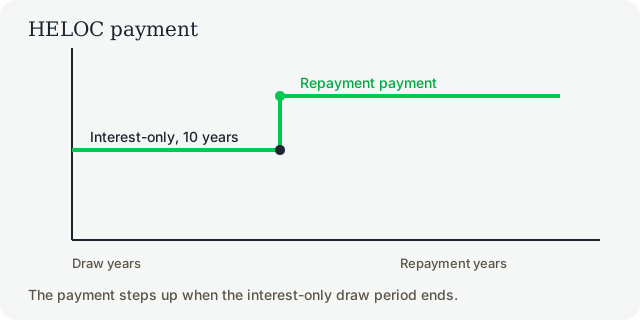
The draw period is when the line is open and the required payment is often interest only. The repayment period is when that balance has to be paid off. On the defaults the switch is month 121, and the payment rises by $79.74, from $354.17 to $433.91. That is a 22.5% jump even if the rate never moves.
People budget the interest-only number and then meet the real payment a decade later. If the rate has also risen, the jump is larger. At 10.5% the whole way, the interest-only payment is $437.50 and the repayment payment is $499.19. The chart's payment view shows the step.
What are HELOC rates today?
The national average HELOC rate was 7.47% on November 18, 2026, according to Bankrate's weekly survey of large lenders (a $30,000 line, 700 credit score, 80% combined loan-to-value). The prime rate, which most lines float on, is 7.00% and has not moved since September 17, 2026. Your quote is prime plus a margin set by your credit and how much of the house you borrow against.
Here is what that spread of rates does to the same $50,000 draw with a 10-year interest-only draw period and a 20-year repayment period. The calculator starts at 8.5%, about a point above today's average, because a real quote often lands above the survey number.
| Rate | Interest-only payment | Repayment payment (month 121) | Payment jump | Lifetime interest |
|---|---|---|---|---|
| 7.00% (prime, no margin) | $291.67 | $387.65 | +$95.98 | $78,035.87 |
| 7.47% (Bankrate average, Nov 18, 2026) | $311.25 | $401.88 | +$90.63 | $83,801.18 |
| 8.50% (calculator default) | $354.17 | $433.91 | +$79.74 | $96,638.79 |
| 9.50% (prime + 2.5) | $395.83 | $466.07 | +$70.23 | $109,355.74 |
Look at the last column before the first. At the average rate, paying only the minimum costs $83,801.18 of interest on $50,000 over 30 years. Paying the same line off like a 10-year loan at 7.47% costs $592.73 a month and $21,127.15 of interest. Same house, same rate, a $62,674.03 difference that comes down to one habit.
HELOC vs home equity loan rates
A fixed home equity loan cost more on paper: Bankrate's November 4, 2026 survey showed 8.66% for 5 years and 8.77% for 10 years. You pay about 1.2 points for a rate that can never rise. A HELOC starts cheaper because you carry the rate risk yourself, which is why the stress section below matters.
Sources: Bankrate HELOC rates, FRED BRMHELOC01, Federal Reserve bank prime rate (H.15). Checked November 19, 2026.
What if HELOC rates rise?
If the rate is higher the entire time, lifetime interest on a minimum-pay $50,000 line is $96,638.79 at 8.5%, $109,355.74 at 9.5%, $122,305.59 at 10.5%, and $135,471.56 at 11.5%. The draw payment moves with the rate every month because it is interest only.
A shock that starts later is a bit kinder than a high rate from day one. Plus 2 points from month 13, with year 1 still at 8.5%, costs $121,305.59 of interest, not the full $122,305.59 of a 10.5% loan. Still five figures more than the base path. Variable means both directions, and you do not get to pick the year it goes up.
How to pay off a HELOC fast
Pay principal on purpose. An extra $100 a month from day one clears this line in 260 months (21 years 8 months) and cuts interest to $59,375.47. An extra $300 clears it in 159 months and cuts interest to $29,345.47. The first payments are $454.17 and $654.17.
The clean version is to pretend it is a 10-year loan. Payment $619.93, interest $24,391.41, balance gone at month 120. That is the number to qualify the draw against, not the $354.17 interest-only figure. If $619.93 does not fit, the draw is too big for a fast payoff, even if the bank will hand you the money. The HELOC payment calculator above will rerun that with your balance and your extra payment.
Using a HELOC to invest: the risks
A HELOC used for a rental down payment stacks two loans on one rent check, and it puts the house you live in behind the bet. If the rental goes vacant, you still owe the first mortgage, the HELOC, and the rental's own loan. Lines can be frozen when prices fall, which is a bad time to need cash. The rate is variable, so last year's payment is not this year's payment.
Run the full deal, not just the HELOC payment. The guide is HELOC for a rental down payment. The deal math, including the month the borrowed down payment is gone, is the borrowed mode in the SFR rental calculator. If the true cash flow is negative, you are paying to hold the deal.
Frequently asked questions
How is a HELOC payment calculated?
During a typical draw period the payment is interest only: balance times the rate, divided by 12. On $50,000 at 8.5% that is $354.17 a month, which feels cheap until the next sentence. When repayment starts, the leftover balance amortizes over the repayment term. Here that payment is $433.91, a jump of $79.74. If you add extra principal, the interest-only payment falls as the balance falls. This is an illustration, not a bill from the bank.
What happens when the draw period ends?
You usually cannot borrow more, and the payment switches from interest-only to a fully amortizing payment. On the default 10-year draw and 20-year repayment, that switch is month 121. The payment goes from $354.17 to $433.91 if you never paid extra and the rate stayed 8.5%. Some lines are interest-only the whole way and then want the full balance. Read the note for which version you actually signed.
How much can I borrow with a HELOC?
A common cap is a combined loan-to-value limit minus the first mortgage. On a $450,000 home with a $250,000 first mortgage and an 85% CLTV cap, the max line is $132,500.00. Drawing $50,000 leaves you at 66.67% CLTV. Lenders also look at credit, income, and whether home values nearby are falling. The max line is a ceiling, not an offer.
Is a HELOC rate fixed or variable?
Most HELOC rates move, often prime plus a margin. The 8.5% used here is an example rate, not a quote. A 2 point rise starting in month 13 takes lifetime interest from $96,638.79 to $121,305.59 if you only pay what is required. The rate can also fall. Do not underwrite a rental on the teaser month.
Is it smart to use a HELOC for a rental down payment?
Sometimes, and only if the rental still cash flows after the HELOC payment and you can survive a higher rate. The house you live in is the collateral. A bad tenant year and a frozen line can land on that same house. Walk through using a HELOC for a rental down payment, then turn on borrowed down payment mode in the SFR rental calculator.
Can I pay off a HELOC early?
Usually yes. There is no prepayment penalty on many owner-occupied lines, but check the note before you assume that. An extra $300 a month on this $50,000 line pays it off in 159 months (13 years 3 months) and cuts interest from $96,638.79 to $29,345.47. Treating the same draw as a 10-year loan costs $619.93 a month and $24,391.41 in interest. Early payoff is allowed in this model. The lender may still charge an annual fee.
What is the average HELOC rate right now?
Bankrate put the national average at 7.47% on November 18, 2026, for a $30,000 line with a 700 credit score and 80% CLTV. Prime was 7.00%. At 7.47% a $50,000 draw costs $311.25 a month interest-only and $401.88 once a 20-year repayment period starts. Treat any average as a starting point and get two or three real quotes.
Is a HELOC or a home equity loan cheaper?
In November 2026 the HELOC started cheaper: 7.47% average versus 8.66% to 8.77% for a fixed home equity loan (Bankrate). The fixed loan costs more because its rate is locked for the whole term. If you will borrow the full amount at once and want a payment that never changes, the fixed loan can be worth the extra point.
What is the payment shock on a HELOC?
Payment shock is the repayment-period payment minus the draw-period payment. On the $50,000 example at 8.5%, the draw payment is $354.17 and the repayment payment is $433.91, a jump of $79.74. The chart shows both payments at the note rate and at 1, 2, and 3 points higher. The repayment term on this page is already 20 years, so no extra term key is added.
How is the max HELOC line calculated?
Max line is home value times the CLTV cap divided by 100, minus the first mortgage, and never below zero. A $400,000 home at 80% CLTV with a $250,000 first mortgage has a max line of $70,000. The payment still uses the amount you draw. If you leave home value or CLTV blank, the page uses the example ($450,000 and 85%), so the payment does not change.
More free loan and debt tools: 15 vs 30 year mortgage, DSCR loan, debt snowball, rent vs buy, cash-out refinance. See the full loans and debt list.
Educational only. Not financial advice. HELOC rates are variable, and a lender can change or freeze the line. The home secures the debt. Example rates, not offers.