

Staking Yield Explained
Staking yield is the reward a proof-of-stake network pays you, in its own token, for locking coins that help secure it. On Ethereum in November 2026 that's about 2.6% a year before fees, and most of it is brand new ETH. Since total supply is growing around 0.9% a year, a staker's real gain in network share is closer to 1.7%. Then come the platform's cut, the tax bill, and the price. Run your own offer through the staking calculator or the crypto real yield calculator. Last reviewed: November 2026.
Educational only. Not financial advice. Staking can lose money through price drops, slashing on some networks, lockups, fees, and platform failures.
Where staking yield comes from
Validators propose and check blocks. You can run one yourself or hand your coins to someone who does. The network pays them, and they pass most of it along to you.
That payment has two sources. The big one is issuance: the protocol mints new tokens. On Ethereum that's roughly 3,000 ETH a day, about 1.1 million a year. The small one is fees and tips that users pay to get their transactions in. With gas fees near the floor lately, very little ETH is burned, so issuance does almost all the work.
This matters for your wallet. A reward funded by fees is someone else's money moving to you. A reward funded by issuance is partly your own slice of the pie being re-cut. Bitcoin doesn't use proof of stake at all, so anything advertised as "Bitcoin staking" is a lending or wrapper product with its own risks.
What staking yield is not
It isn't a bank deposit. Nobody insures the principal, and the price can halve while your coin count climbs. It isn't a dividend either, because no company is sharing profits. The protocol is following its own rules, and those rules change when the staking ratio or governance does.
And it isn't household cash flow until you sell. Extra tokens only pay the electric bill after you convert them, pay the tax, and accept whatever the price is that day.
Nominal yield vs real yield
The nominal yield is the number on the dashboard. Real yield is what's left once you subtract the things that quietly eat it. People mean two different things by it, so here's the math for both.
Real yield as your share of the network
Divide one plus your reward rate by one plus supply growth. Ethereum's 2.63% against 0.9% growth works out to about 1.7% more of the network each year. Now picture a token paying 10% while supply grows 6%. Your coin count jumps 10%, but your slice grows only about 3.8%. Everyone who doesn't stake gets diluted to pay you.
Real yield in dollars you can spend
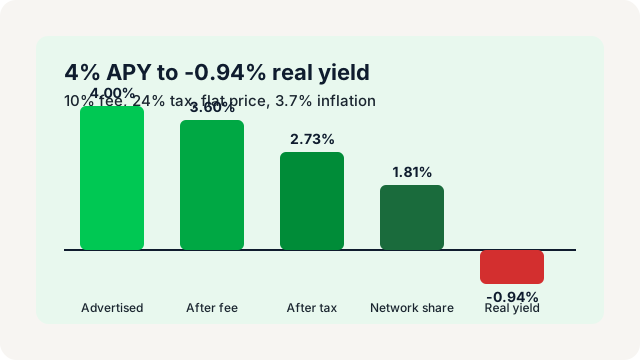
Take a 4% APY. A 10% validator cut leaves 3.60%. A 24% tax on each reward leaves 2.73%. If the price is flat and inflation runs 3.7%, the latest official CPI figure, your buying power shrinks 0.94% a year. That's the version that matters for cash flow. Our crypto real yield calculator runs it with your numbers, and the price slider usually ends up doing most of the talking.
APR vs APY in staking
APR is the simple yearly rate. APY assumes you restake rewards so they earn rewards too. At staking rates the gap is tiny: 3.60% APR restaked monthly is 3.66% APY, and daily restaking only nudges it to about 3.67%. If restaking costs you a transaction fee each time, monthly can beat daily.
Before you compare two offers, find out whether the number is before or after the provider's cut, and whether it assumes automatic restaking. Dashboards don't always use the labels the way a bank would.
What moves the headline rate
On Ethereum the reward budget grows with the square root of the total amount staked. Double the stake and the budget rises only about 41%, so each staker gets less. That's why the network rate slid from around 2.8% in January 2026 to roughly 2.6% by November, as staked ETH climbed past 44 million, about 36% of supply.
Fee activity can push it back up when the network gets busy. Validator downtime and commission pull it down. Governance can change the issuance curve too, and in 2026 there was a serious proposal to cut issuance as stake grows. It was set aside, but the debate isn't over, so don't treat today's rate as a contract.
Ways to stake and what they cost
| Path | Typical cut of rewards | What can go wrong |
|---|---|---|
| Solo validator | 0%, plus hardware and your time | Downtime penalties, slashing, losing your keys |
| Delegated or pooled staking | About 10% to 15% | Operator mistakes, shared penalties |
| Liquid staking token | About 10% | Smart-contract bugs, the token trading below the coin it represents |
| Exchange staking | About 15% to 25% | The platform holds your keys, can change terms, or can fail |
On a 2.63% network rate, a 25% cut leaves you about 1.97%. A 10% cut leaves about 2.37%. That 0.4-point gap is bigger than the whole APR vs APY debate.
Taxes on staking rewards
In the US, the IRS said in Revenue Ruling 2023-14 that staking rewards are income in the year you gain control of them, at their market value that day. When you sell, you have a separate capital gain or loss measured from that value. If the price falls after you receive a reward, you still owe tax on the higher number, which is why plenty of stakers sell a slice of each reward to cover it.
Brokers began sending Form 1099-DA for 2025 sales, so more of your crypto activity now shows up on the IRS side. Keep your own records anyway: date, token amount, and dollar value at receipt. Rules differ by country and change often. Ask a tax pro. This isn't tax advice.
Turning rewards into cash flow
If you want staking to act like an income line, treat it like a small experiment and write everything down. Log each reward with its date, amount, and dollar value. Log the fees. Then pick a rule and stick with it, such as selling enough each month to cover the tax and keeping the rest, or selling all of it and calling that the paycheck.
On $10,000 at a 3.60% net rate and a 24% tax bracket, selling every reward pays about $22 a month. That's a nice dinner, not a mortgage payment. Size the stake so a total loss wouldn't change your life. Record it in the Crypto Tracker and see the full routine in Tracking Crypto Cash Flow. If you plan to pull cash out regularly, the crypto withdrawal calculator shows how a bad year, a cash buffer, and tax change what is safe to take.
Staking yield FAQ
What is staking yield?
Staking yield is the yearly reward a proof-of-stake network pays for locking tokens that help validate blocks. It is paid in the same token, mostly newly minted. On Ethereum in November 2026 it runs about 2.6% a year before any provider fee.
Is a higher staking APY always better?
No. A token paying 15% while its supply grows 12% leaves you with a smaller slice of the network after tax. Compare the APY to the supply growth, the fee, and the lockup before you rank two offers. The crypto real yield calculator does that math.
What is the difference between staking APR and APY?
APR is the simple yearly rate. APY assumes rewards are restaked and compound. A 3.60% APR restaked monthly is a 3.66% APY. The gap is small at staking rates, so the fee usually matters more than the compounding.
Does staking protect me if the token price falls?
No. A 3.66% APY over three years adds about 11% more coins. A price drop of a little over 10% erases all of it in dollars, and crypto prices can fall far more than that in a month.
Are staking rewards taxed?
In the US, yes. Revenue Ruling 2023-14 treats staking rewards as income in the year you gain control of them, at their value that day. Selling later creates a separate gain or loss. Rules differ by country. Not tax advice.
How is staking different from yield farming?
Yield farming puts tokens into DeFi pools or lending markets for fees and incentive tokens. It adds impermanent loss and more smart-contract risk on top of price risk. See yield farming vs staking.
Next steps
- Crypto real yield calculator: your APY after fees, tax, dilution, and inflation
- Crypto staking calculator: reward coins and the price drop that erases them
- Yield farming vs staking: the risks side by side
- Crypto Start Here and the Crypto FAQ
- Crypto cash flow hub
Educational only. Not financial or tax advice. Network figures are approximate as of November 2026 and change daily. Nothing here guarantees returns or income.
For a dollar illustration of whether Ethereum staking is worth it when the price falls, see is Ethereum staking worth it. Taxes on rewards are covered in crypto staking taxes.