

Business · what a buyer might pay
Small Business Valuation Calculator
Short answer
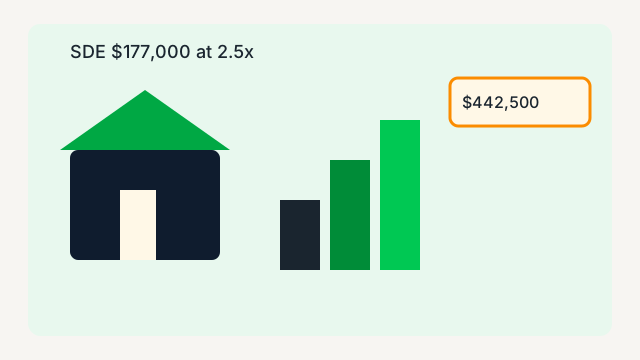
Most small businesses sell for about 2 to 4 times SDE. In Q3 2026, deals under $1 million closed at an average 2.30 times cash flow and deals over $1 million at 3.73 times (BizBuySell). On this page, $90,000 of net profit is $177,000.00 of SDE once you add back owner pay, one-time costs, depreciation, and interest. At 2.5 times SDE the shop prices at $442,500.00, inside a range of $354,000.00 to $531,000.00. A buyer with 10% down still shows a 1.81 DSCR on an example 10.5% loan. A multiple is an opinion you type, not a bid. Last reviewed: November 2026. Illustration, not a forecast.
Last reviewed: November 2026. Illustration, not a forecast.
Business valuation calculator
This business valuation calculator answers what seller's discretionary earnings support as a price, and whether a buyer's loan still covers. It is for an owner sketching a sale, not for a formal appraisal. It turns a year of profit, owner pay, and add-backs into a low-to-high price and debt coverage on the mid price. Multiples are numbers you type. The loan rate is an example. The honest catch: buyers verify tax returns. Educational only. Not financial, legal, or tax advice.
This business valuation calculator is an illustration, not an appraisal. Add-backs have to be documented. Buyers and lenders verify tax returns. Educational only. Not financial, legal, or tax advice. Real valuations depend on verified financials, industry, and buyer demand. Example loan terms, not offers.
How to use this calculator
- Enter a year of revenue and net profit before tax.
- Add back salary you already deducted, and only the perks and one-time costs you can point to on a statement. The worksheet for extra owner pay, one-time costs, and depreciation starts at $0.
- Add depreciation, amortization, and interest so the new buyer's loan is not stacked on your old one.
- Set a low, mid, and high multiple. Leave them near 2 to 3 unless you have a reason. The Main Street slider starts at 2.5x. 2x to 4x SDE is a sketch for a Main Street business, not a quote.
- Set a manager wage and an example down payment, rate, and term. Read DSCR and payback together.
- Open the ladder before you fall in love with the high multiple.
What the numbers mean
- SDE
- Net profit plus owner salary, add-backs, depreciation, amortization, and interest. The benefit of ownership before a replacement manager. The example is $177,000.00.
- Mid value
- SDE times the mid multiple. $177,000.00 times 2.5 is $442,500.00.
- Buyer DSCR
- SDE minus the manager wage, divided by annual debt service. The example is 1.81. Coverage, not an approval.
- Payback
- Mid price divided by SDE after the manager wage. The example is 3.78 years.
- Worksheet add-backs
- Owner pay, one-time costs, and depreciation. All three start at $0, so SDE stays $177,000.00. A stated profit of $90,000 plus $40,000 of owner pay, with the other add-backs at $0, is $130,000.00 of SDE.
- Main Street multiple
- A slider from 2x to 4x. That band is a sketch for a Main Street business, not a quote. It starts at 2.5x, so the mid value stays $442,500.00.
Worked example: $600,000 revenue, $177,000 SDE
The default year on this business valuation calculator is $600,000 of revenue and $90,000 of net profit. The owner already took a $60,000 salary. Add-backs are $15,000. Depreciation and amortization are $8,000. Interest is $4,000. Add those to the $90,000 and SDE is $177,000.00. The margin is 29.50% of revenue.
At 2.0 times SDE the price is $354,000.00. At 2.5 times it is $442,500.00. At 3.0 times it is $531,000.00. The revenue multiple on the mid price is 0.74 ($442,500.00 divided by $600,000, or 0.7375). If that ratio looks silly next to shops you know, the multiple is the dial to move. The business valuation calculator will not argue with you.
A manager who replaces the owner costs $60,000. Adjusted EBITDA is $117,000.00. At 4.0 times, that path prices the business at $468,000.00, close to the 2.5 SDE price and not the same idea. One price assumes you stay. The other assumes you hire.
The buyer of the mid price puts $44,250.00 down and borrows $398,250.00. At an example 10.5% for 10 years, annual debt service is $64,485.43. DSCR is 1.81. Cash flow after debt, before the wage, is $112,514.57. After the wage it is $52,514.57. Payback is 3.78 years. Cash-on-cash on the down payment is 118.68%. That last percent looks huge because the down payment is small and the wage is already a full salary. It is not a yield you can clip coupons from.
What is SDE and how do you calculate it?
SDE is the clean-up of a tax return so a buyer can see what the owner really kept. Start with net profit. Add the salary that profit already lost. Add personal costs and one-time hits. Add non-cash depreciation and amortization. Add interest, because the buyer brings a new loan. The business valuation calculator does that addition and stops. It does not audit the return.
The trap is the add-back you wish were true. A truck the business needs is not a perk. A "one-time" repair that happens every March is not one-time. If the $15,000 comes out, SDE falls and every multiple falls with it. Use the no-add-backs chip when you want to see the stern version. Then put back only the lines a buyer would accept in a room with your tax return on the table.
Owner salary is an add-back only if it was an expense. A sole prop that never ran payroll may already have the owner's benefit inside net profit. Adding it twice inflates SDE. The business valuation calculator cannot see your entity type. You can. If the $60,000 was never deducted, set that box to zero.
On the business valuation calculator, margin is SDE divided by revenue. 29.50% is a healthy example, not a target for every trade. A reseller with 8% SDE margin and a consultant with 40% are different businesses even when SDE dollars match. Price follows the dollars. Risk follows the margin, the concentration, and whether the phone still rings when you leave.
SDE multiples and what moves them
A multiple is a opinion about risk and growth, written as one number. Typical small businesses often trade around 2 to 3 times SDE, but it varies a lot. This business valuation calculator lets you set the low, mid, and high ends instead of pretending one number fits a bakery and a software shop. There is no database behind the slider.
On the business valuation calculator, what pushes a multiple up: recurring revenue, more than one person who can do the work, clean books, customers who are not one contract, and a reason the earnings continue. What pushes it down: you are the product, the books are a shoebox, one client is half the year, or the equipment is tired. None of that is in the form. It is why you might type 2.0 instead of 3.0.
The ladder on the business valuation calculator holds the loan terms still and moves only the multiple. At 1.5x the price is $265,500.00 and DSCR is 3.02. At 2.0x, $354,000.00 and 2.27. At 2.5x, $442,500.00 and 1.81. At 3.0x, $531,000.00 and 1.51. At 3.5x, $619,500.00 and 1.30. A higher price is not free. The same earnings have to cover a larger note. Read the DSCR column before you celebrate the top row.
The heatmap crosses those multiples with rates from 8% to 12%. The outlined cell is your mid multiple and your rate when they sit on that grid. A 2.5x price at a higher example rate covers less. The rate is still an example. It is not a quote, and it is not a forecast of next year's credit market.
What multiple do small businesses sell for in 2026?
Most Main Street businesses sell for about 2 to 4 times cash flow, and size moves the number more than anything. In BizBuySell's Q3 2026 report, businesses that sold for under $1 million averaged 2.30 times cash flow, while those above $1 million averaged 3.73 times. BizBuySell's "cash flow" is the same idea as SDE on this page.
| Segment | Median sale price | Median cash flow | Average multiple | Sale price vs asking |
|---|---|---|---|---|
| All reported sales (2,132 deals) | $350,000 (+17% from a year earlier) | n/a | Up 2.6% from a year earlier | n/a |
| Sold under $1 million | $250,000 | $123,000 | 2.30x | 93.6% |
| Sold over $1 million (22% of deals) | $1.8 million | $559,000 | 3.73x | 100.8% |
| Manufacturing | $807,000 | n/a | 3.02x | n/a |
Run this page's example through the market average. $177,000 of SDE times 2.30 is $407,100. That is $35,400 below the $442,500 the 2.5x mid multiple produces, and smaller deals also closed at 93.6% of asking. A seller who wants the higher number needs the things that earn it: steady recurring customers, books a lender will accept, and a business that runs for a week without the owner answering the phone.
What an SBA acquisition loan costs now
Most buyers of a business this size borrow through the SBA 7(a) program. For a variable-rate loan above $350,000, the rate cap is prime plus 3 points, which is 10.00% with prime at 7.00%. Loans from $250,001 to $350,000 can go to 11.50%. The calculator's example loan uses 10.5%, a little above today's ceiling for a loan this size, so read it as a stress case and type 10 to see the cap.
Sources: BizBuySell Q3 2026 Insight Report, SBA 7(a) loans, 13 CFR 120.214. Checked November 19, 2026.
SDE vs EBITDA
SDE answers "what does the owner keep if the owner does the job?" EBITDA, after a market wage, answers "what is left if someone else does the job?" On this business valuation calculator the wage is $60,000, adjusted EBITDA is $117,000.00, and a 4.0 multiple is $468,000.00. The SDE mid price is $442,500.00. Close, and not the same sentence.
On the business valuation calculator, use SDE when the buyer is another operator who will work the counter. Use the EBITDA path when the buyer is hiring a manager or already has one. Subtracting the wage twice, once inside a low SDE and again as EBITDA, is a good way to talk yourself into a sad price. Pick the path that matches who buys.
On the business valuation calculator, depreciation was added back because it is not cash. The assets still wear out. A buyer who believes the $8,000 add-back and then discovers a $40,000 van is due is not wrong to argue. The business valuation calculator does not schedule capital replacements. Mention them in the sale conversation, or the multiple will do it for you in the other direction.
Interest comes out so you are not valuing your old loan. The buyer's new payment shows up later, in DSCR, not inside SDE. Mixing the old interest and the new payment is double counting. Leave interest in the add-back box and let the loan panel price the new note.
The buyer's math: loan, DSCR, and payback
The buyer price in this business valuation calculator is the mid SDE value. Down cash is that price times the down payment percent. The loan is the rest. Annual debt service is the monthly payment times 12, using the example rate and term. DSCR divides SDE after the manager wage by that debt service. Say it plainly: the lender pays a wage first, then asks if the leftover covers the note.
On the defaults the wage leaves $117,000.00. Debt service is $64,485.43. Coverage is 1.81. Payback is the mid price divided by that same $117,000.00, which is 3.78 years. Cash flow after the wage and the debt is $52,514.57 a year, about the down payment of $44,250.00 with room, which is why cash-on-cash prints 118.68%. A 10% down payment makes almost any healthy leftover look enormous. Look at dollars, not only the percent.
The same DSCR idea shows up on rentals in the DSCR loan calculator. There, rent covers a house note. Here, earnings after a wage cover a business note. The ratio is familiar. The collateral, the lender, and the risks are not. Do not copy a rental rule onto a shop without a lender who actually makes that loan.
If SDE falls, DSCR falls in a straight line. The stats strip shows how far SDE can drop before coverage hits 1.25, holding the wage and the payment still. That is a stress test, not a covenant from a term sheet. If the payment never fits, lower the multiple or raise the down payment. The business valuation calculator would rather show a smaller price than a story that needs a perfect year.
Selling for retirement cash flow
A sale is one check, then the check has to become income. $442,500.00 before tax, fees, and a loan payoff is not a retirement plan until you know what it can throw off. Read the owner retirement cash flow plan before you treat the mid price as the finish line. This business valuation calculator prices the shop. It does not invest the proceeds.
Many owners need the business to keep paying them while a buyer takes over. That can be a seller note, a stay-on wage, or both. Price a note you carry in the seller financing calculator. This page models a bank-style loan and a market wage. It does not model a balloon or an earnout. If those are the deal, the DSCR above is only the bank piece. The rest is a conversation with a buyer and a tax pro, not a second slider.
Keep a path that does not need a sale. The business valuation calculator is not that path. Owner pay taken on purpose, and surplus moved into assets that pay you, is the other track. A high multiple that never closes is worth less than a smaller surplus you actually saved. The business valuation calculator is useful when a buyer is real. It is a distraction when the plan is "someday."
After a sale, the cash flow question is the same one the rest of the site asks: what monthly income replaces the owner draw? Run that number before you sign. A price that looks large next to a salary can look small next to a rent roll or a dividend stream you have to build from scratch. Illustration, not a forecast. Nothing in the price is a promise of a buyer.
Frequently asked questions
How do I calculate what my small business is worth?
Add owner salary, documented add-backs, depreciation, amortization, and interest back to net profit. That sum is SDE. Multiply by a range of multiples. On this business valuation calculator, $90,000 of net profit becomes $177,000.00 of SDE. At 2.0x, 2.5x, and 3.0x the prices are $354,000.00, $442,500.00, and $531,000.00. The multiple is your input, not a quote from a market.
What is SDE?
SDE means seller's discretionary earnings. It is the profit a full-time owner can take home before a market wage for a replacement manager. The business valuation calculator builds it as net profit $90,000 plus salary $60,000 plus add-backs $15,000 plus depreciation and amortization $8,000 plus interest $4,000. SDE is $177,000.00, which is 29.50% of $600,000 revenue.
What multiple of SDE do small businesses sell for?
Typical small businesses often trade around 2 to 3 times SDE, but it varies a lot by industry, size, customer concentration, and how transferable the work is. This business valuation calculator does not look up a multiple. You type 2.0, 2.5, and 3.0, or any other range. A 1.5x case is $265,500.00. A 3.5x case is $619,500.00. Neither is a promise.
What is the difference between SDE and EBITDA?
SDE still includes the benefit of an owner who works in the business. Adjusted EBITDA subtracts a market wage for a manager. Here that wage is $60,000, so adjusted EBITDA is $117,000.00. At a 4.0 multiple the EBITDA value is $468,000.00. The business valuation calculator shows both so you can see the gap between "I run it" and "I hire someone."
What DSCR do lenders want for a business loan?
Many lenders want coverage above 1.25, and some want 1.50. This page does not speak for a lender. On the example, a buyer of the $442,500.00 mid price puts 10% down ($44,250.00) and borrows $398,250.00 at an example 10.5% for 10 years. Annual debt service is $64,485.43. DSCR after the manager wage is 1.81 (1.8144 before rounding). That is an illustration, not an approval. Get real quotes.
Can I sell my business with seller financing?
Sometimes. A buyer may pay part of the price over time, and the tax treatment of an installment sale is a tax-pro question. This business valuation calculator prices a bank-style loan on the mid value. It does not price a seller note, a balloon, or an earnout. Owner cash flow after debt on the example loan is $112,514.57 before a market wage and $52,514.57 after it.
What is on the add-backs worksheet?
Three extra lines: owner pay, one-time costs, and depreciation. Each starts at $0, so seller's discretionary earnings stay $177,000.00 on the example. Add $40,000 of owner pay to a stated profit of $90,000, with salary, the older add-backs, depreciation, and interest at $0, and SDE is $130,000.00. Do not type a cost that is already in Owner salary paid, Owner add-backs, or Depreciation and amortization.
Does the page price SDE or EBITDA?
It starts on SDE, which is the method the value range already uses. Switch the toggle to EBITDA and the headline features adjusted EBITDA of $117,000.00 times 4.0, or $468,000.00. The buyer loan still uses the SDE mid price of $442,500.00 unless you move the Main Street slider off 2.5x.
What is the average SDE multiple for a small business in 2026?
BizBuySell's Q3 2026 report put the average at 2.30 times cash flow for businesses that sold under $1 million and 3.73 times for those above $1 million. Manufacturing averaged 3.02 times. Applied to this page's $177,000 of SDE, 2.30 times is $407,100. Your industry, customer mix, and how much the business depends on you can move it either way.
What interest rate does an SBA loan to buy a business carry in 2026?
The SBA caps variable 7(a) rates at prime plus a spread that depends on loan size. With prime at 7.00% in November 2026, the cap is 10.00% above $350,000 and 11.50% from $250,001 to $350,000. Lenders may charge less. Plug a real quote into the loan rate field to see the buyer's DSCR and payback.
What does the 2x to 4x slider mean?
2x to 4x SDE is illustrative for a Main Street business, not a quote. The slider starts at 2.5x, the same mid multiple this page already uses, so the example mid value stays $442,500.00. Move it and the mid price follows. The low and high boxes stay at 2.0x and 3.0x until you change them.
More free tools: Side hustle · Freedom date
Educational only. Not financial, legal, or tax advice. Real valuations depend on verified financials, industry, and buyer demand. Example loan terms, not offers. A multiple you like is still not a check.