

Crypto · rewards after the commission
Crypto Staking Calculator
Short answer
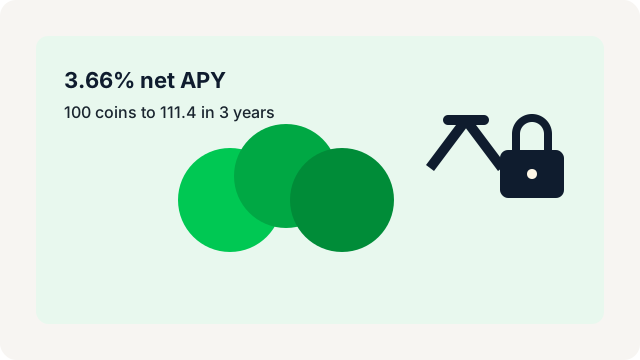
A 4% APR with a 10% commission is a 3.66% net APY if you restake monthly. Three years turns 100 coins into 111.3868. That is $1,138.68 of rewards at today's $100 price, and a 10.22% price drop wipes it out. Pretty coins, thin dollars. For scale, Ethereum staking pays about 2.6% a year before fees in November 2026, and a 3-month T-bill pays about 4.3% with no price risk at all.
Last reviewed: November 17, 2026. Rates checked against Treasury and network data; tax treatment per IRS Rev. Rul. 2023-14. Illustration, not a forecast.
Staking calculator
This staking calculator answers what an APR pays after the cut, in coins and in dollars. It is for someone comparing a reward rate with the price drop that erases it. You type the price. There is no live feed and no coin name in the defaults. The honest catch: commission stays in the math, and a price move can eat the whole reward. Educational only. Not financial or tax advice.
This staking calculator is an illustration. Example rates, not offers. If the coin price is zero, the page asks for a price instead of printing a broken number.
How to use this calculator
- Type the dollars and the coin price. The page starts at $10,000 and $100.
- Type the APR and the commission. Read the net APR before you admire the APY.
- Pick daily, weekly, monthly, or no restake, and the number of years.
- Move the price change, or use the total -50% and +50% chips.
- Check lockup, whether you hold the keys, and whether the stake is a small slice of net worth.
- Read the price-drop line before you treat reward coins as money you can spend.
What the numbers mean
- Net APR
- The APR after the validator or platform takes its cut. 4% with a 10% cut is 3.60%.
- Net APY
- That net rate compounded at your restake frequency. Monthly is 3.66%.
- Wipeout drop
- A 10.22% fall in price over the whole period puts the ending coins back near the starting dollars, if you started from a flat price.
- Monthly cash
- $30.00 if you sell the net rewards each month at today's price and do not restake. It dies if the price dies.
- Tax at receipt
- Starts at 0%. Reward coins stay the same. The dollar line is reward value at the scenario end price, times the percent.
- Unbonding
- Days you may wait to get out. It does not change the reward math. The default is 21 days.
Worked example: $10,000 at 4% APR
The default on this staking calculator is $10,000, a $100 coin, a 4% APR, a 10% commission, monthly restaking, 3 years, and a flat price. You start with 100.0000 coins. The net APR is 3.6000%. The net APY is 3.6600%. You end with 111.3868 coins. Rewards are 11.3868 coins. At $100 that pile is worth $11,138.68, and the rewards are $1,138.68.
Sell the rewards each month instead of restaking and the cash flow is $30.00 a month at today's price. That figure does not grow, because you are not adding coins. It also dies if the price dies. Thirty dollars is the illustration, not a paycheck. If you plan to live on a bigger stack by selling coins, the crypto withdrawal calculator shows how long that lasts when a crash comes first.
Daily restaking ends at 111.4042 coins, a 3.6654% APY, and $11,140.42. No restake ends at 110.8000 coins, a 3.60% APY, and $11,080.00. The chart shows all three side by side, so the compounding argument has to win by actual coins, not by a slogan.
A total price drop of 50% over the 3 years leaves the same 111.3868 coins worth $5,569.34. A total rise of 50% leaves them worth $16,708.01. Same APR. The dollars are the price. Run your own APR in the staking calculator. Do not borrow the 4% as if it were a quote.
APR vs APY in staking
APR is the rate before rewards are added back. APY is the rate after they are. On a 3.60% net APR, one year of monthly compounding is a 3.66% APY. The gap is small because the rate is small. People advertise the bigger of the two. This staking calculator prints both.
Restaking monthly means each month you add coins times net APR divided by 12. Next month the base is a little larger. Over 3 years that loop is 36 additions. Daily is 1,095 additions. The extra coins from daily versus monthly are 0.0174 on this example. If claiming costs money, daily is a hobby, not a raise.
No restake means rewards equal starting coins times net APR times years. 100 times 3.60% times 3 is 10.8000 coins, and you finish at 110.8000. You still have the rewards. You just do not earn rewards on the rewards. For cash flow, that can be the point: you sell them. The monthly cash line is that choice, priced at today's coin, not at a hoped-for future coin.
None of these rates include a new-token faucet that dilutes you. An APR can be offset by new issuance. If the chain mints rewards faster than the real demand for the coin, the APY is a coin story and the dollar story is the price chart. Read the price section before you pick a frequency.
Change one input at a time. A calculator that only shows coins will flatter you, which is why this one keeps the dollar value and the wipeout drop on the same row as the APY.
Validator and platform fees
Commission is a cut of rewards, not of your principal. Ten percent of a 4% APR is 0.40 points. You keep 3.60%. The math applies that cut before compounding, which is how a validator skim actually works: they take their share of each reward, and you compound what is left.
For a real-world version of this, Is Ethereum staking worth it? compares Lido, Rocket Pool, Coinbase, and solo staking at November 2026 rates, where fees take the same network reward from about 2.5% down to 1.6% to 2.7%.
The checklist calls commission under 10% a pass. The default 10% is a watch, on purpose. "Under 10" does not include 10. A 0% commission is not free if the validator is sloppy or the platform is the one holding the coins. A low cut on a platform you cannot exit is still a lockup story.
Compare the commission in coins, not in a banner. The gap versus a zero-commission restake at the same APR is the cost. Dollars on that gap use the scenario end price, so a rally makes the fee look larger and a crash makes it look smaller. Coins are the honest unit, and you get both.
Some platforms quote a rate that is already net. If you then type that rate and also type a commission, you skim twice. Read the footnote on the rate card. If it already removed the fee, set commission to zero here. The math will not know you double-counted unless you do.
Price risk: rewards in coins, bills in dollars
Staking pays coins. Rent, tax, and groceries are dollars. A 3.66% coin yield loses to a 10.22% price drop over the same 3 years. That wipeout line is 1 minus starting coins divided by ending coins. It does not care what the APR brochure said. The calculator puts that percent right next to the APY, so they have to share a screen.
The -50% chip is a total drop over the whole period, not 50% every year. The page converts it into the annual rate that lands on half the starting price after your year count. At 3 years the ending value is $5,569.34. The +50% chip lands on $16,708.01. Both still have 111.3868 coins. Only the price changed. Treat both as sketches. Crypto can lose most of its value, and it can do it faster than a smooth annual rate.
The heatmap crosses APR from 2% to 10% with a total price change from -50% to +50%. A higher APR does not repair a crash. It adds coins. If the price is cut in half, you need a pile of coins you probably do not have. Find your dollar cell, then decide whether the stake is play money or rent money. Those are different jobs.
There is also a quiet version of price risk: the years it takes for rewards to equal a 50% crash. That is the time to double the coin count at a flat price. At 3.60% net, that is a long wait. If you need the dollars sooner, you are hoping for price, not for yield. Hope is not a cash-flow plan.
Stablecoin yield vs a savings account
The comparison is one year of monthly compounding on the same dollars. A 4.5% stablecoin example pays $459.40. A 3.8% savings example pays $386.69. That is not a vote for the stablecoin. It is a $72.71 gap that can vanish in a depeg, a freeze, or a platform failure. And the bar keeps moving: a 3-month Treasury bill paid about 4.3% on November 17, 2026, backed by the government and free of state tax. Run the stablecoin yield vs T-bill calculator before you chase the coin rate.
A savings APY is a dollar rate from an account with its own rules, insurance limits, and fine print. A stablecoin rate is a dollar story only while the coin stays near one dollar. Issuer risk, platform risk, and depeg risk sit next to the higher number. Example rates, not offers. Get a real savings quote if you want a bank comparison. Do not treat 3.8% as this month's rate.
Staking a volatile coin and holding a stablecoin are different bets. One pays you in a coin that moves. The other pays you in a coin that claims not to move and sometimes does. Neither is the $30 a month you get from selling staking rewards, and neither is a wage. If you need a number you can plan a bill around, start with the smaller figure and assume it can go to zero in the crypto case.
The rates are inputs. Change them. Hide the savings line and the coin yield looks lonely and important. Parked next to a plain savings balance, 11 coins in 3 years has to justify the extra ways it can fail.
Staking risks
Slashing can cut coins if a validator misbehaves. Lockups and unbonding mean you cannot leave on the day the price breaks. A platform or exchange can fail while it holds the keys. Smart-contract risk means the code can do something you did not intend. Token inflation means new coins can offset the APR you just modeled. Taxes can turn a coin reward into a dollar bill before you sell.
The checklist is a CFS risk check, not a grade and not advice. Commission under 10%, lockup under 30 days, you hold the keys, a reminder that rewards may be taxed when received, and a stake under 10% of net worth if you type one. Pass or watch is text, not a trophy. A row of passes does not make the coin safe.
Read the guides before you raise the APR box. Staking vs yield farming risks covers what can break. Staking yield explained covers what the yield is in cash-flow words. Then come back and run the staking calculator with the rate you were actually offered, not the rate in an ad.
In the US, staking rewards are ordinary income in the year you gain control of them, valued at their dollar price that day. The IRS said so in Revenue Ruling 2023-14. That value becomes your cost basis, so a later sale only taxes the change. Here is the trap: if the price drops after you receive the coins, you still owe tax on the higher value, and the loss only helps once you sell. Form 1099-DA reports sales, starting with 2025 transactions, but many platforms will not report the rewards themselves, so log them in the crypto income journal. The tax box here is a percent you type, not a filled-in return. Not advice.
Staking FAQ
How are staking rewards calculated?
Coins equal dollars divided by the price you type. On this staking calculator, $10,000 at $100 is 100 coins. A 4% APR with a 10% commission is a 3.60% net APR. Monthly restaking turns that into 3.66% APY. After 3 years you have 111.3868 coins, which is 11.3868 reward coins.
What is the difference between APR and APY in staking?
APR is the simple yearly rate before compounding. APY is what you get if rewards are restaked. At a 3.60% net APR, monthly restaking is 3.66% APY and daily restaking is 3.6654% APY. No restake stays at 3.60% and ends at 110.8000 coins, worth $11,080.00 if the price does not move.
How often should I restake?
On these numbers, daily restaking ends at 111.4042 coins and $11,140.42. Monthly ends at 111.3868 coins and $11,138.68. The gap is about two cents of a coin over 3 years. Restake when the extra coins beat the fee and the hassle. This staking calculator does not know your gas cost.
Are staking rewards taxed?
In the US, staking rewards are generally treated as income when you receive them. The tax box starts at 0% and only prices the percent you type against reward dollars. It is not a tax return. A 3.66% coin yield can still leave a tax bill in dollars. Check the rules where you live. Not advice.
Can I lose money staking?
Yes. The same 111.3868 coins are worth $5,569.34 if the price falls 50% over 3 years, and $16,708.01 if it rises 50%. A 10.22% price drop erases the rewards and puts the pile back near the $10,000 you started with. Slashing, a lockup, or a dead platform can do worse. Nothing here is a promise.
Is stablecoin yield safer than staking?
It is a different risk, not a smaller one by default. On $10,000 for one year, a 4.5% stablecoin rate compounded monthly pays $459.40 and a 3.8% savings rate pays $386.69. Those are example rates, not offers. A stablecoin can lose its peg, and the issuer or the platform can fail. A savings account has its own limits. This staking calculator only shows the interest math.
What does tax at receipt change?
The tax box starts at 0%, so the reward coins and the default dollar hero stay put. The line is reward dollars at the scenario end price, times the percent. On the flat default, rewards are $1,138.68, so 24% is about $273.28. It does not sell coins. It is not a tax return. Check with a tax pro.
What does the price scenario assume?
Price change per year starts at 0, so the end price is the coin price you typed. No gain or loss until you move it. The -50% and +50% chips are total moves over the whole period, not a history. Illustration, not a forecast.
Does the unbonding period cut the rewards?
No. Unbonding days are a label. The default is 21 days. Changing it does not change coins, APY, or the dollar hero. A long wait still matters if you need to leave when the price breaks.
Educational only. Not financial or tax advice. Crypto is volatile, staking has lockup and slashing risk, and rates change. Example rates, not offers. Leave the commission in the math. A zero cut is a different illustration.