

Real estate · The note, the balloon, the price
Seller Financing Calculator
Short answer
This is for a buyer or a seller looking at an owner-carry, and the balloon is the part people skip. A $200,000 sale with 10% down carries $180,000.00 at 7%. The payment is $1,197.54. The year-5 balloon is $169,436.86. A note buyer who wants 10% would pay about $159,344.66 for that stream. Interest-only is off, so that payment stays put. A separate check on a $250,000 note at 7% for 30 years, due in 5 years, is $1,663.26 a month and about $235,329 due. Last reviewed: November 2026. Illustration, not a forecast, and not a note a title company will sign.
Last reviewed: November 2026. Illustration, not a forecast.
Seller financing calculator
This seller financing calculator prices a new owner-carry note and, in the other mode, an existing note you might sell. You get the payment, the balloon, what the seller collects, and what the note is worth at a discount rate. Educational only. Not legal, tax, or financial advice.
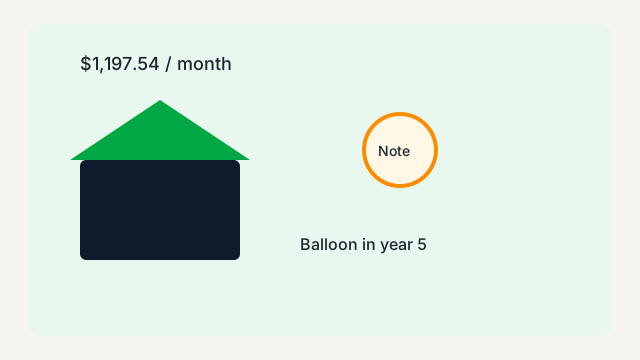
This is an illustration, not a note, a closing, or an offer to buy a note. If the payment does not cover interest, the page says the note never pays off instead of printing a fantasy term. Educational only.
How to use this calculator
- Start in new-note mode with the price and the down payment. The down payment is your cushion if the payments stop.
- Set the rate, the amortization, and the balloon year. Zero means the note runs to the end, and you are the bank for decades.
- Set the discount rate to the yield a note buyer would demand. Read the present value next to the loan, not instead of the balloon.
- Leave the bank rate as a comparison. It is an example, not a quote, and a real quote can erase the savings.
- Switch to the existing-note chip when you already hold a note and want a price for it.
- Save two scenarios before you agree to carry five years of someone else's mortgage.
What the numbers mean
- Payment
- $1,197.54 on the example, from a standard fully amortizing formula. A pretty payment is not the same as a paid-off note.
- Balloon
- Balance after 60 payments: $169,436.86. Most of the loan is still there, which is the part people skip when they like the monthly number.
- Seller receives
- Down payment plus every scheduled payment plus the balloon: $261,289.53. That total assumes everyone pays.
- Note value
- Those same payments discounted at 10%: $159,344.66, or 88.52% of face. Face and price are not the same check.
- Closed-form balloon
- Payment is principal times r divided by (1 minus (1+r) to the minus n). Balance is principal times (1+r) to the k, minus the payment times ((1+r) to the k minus 1) divided by r. On $250,000 at 7% for 30 years, due in 5 years, the payment is $1,663.26 and the balance is about $235,329.
- Interest-only
- Off by default. On means the payment is principal times the rate divided by 12, and the balloon is the full principal. Off returns the existing schedule.
- Seller cash yield
- When the dollar discount is 0, the yield is the note rate. When the discount is above 0, cash-on-cash is annual interest (note principal times the note rate) divided by sale price minus the discount. Not an IRR. The buyer payment does not change.
Worked example: $200,000 sale with 10% down
The default on this seller financing calculator is a $200,000 price, 10% down, 7% interest, a 30-year amortization, and a balloon in year 5. The loan is $180,000.00. The payment is $1,197.54. Sixty payments add up to $71,852.67. Interest inside those payments is $61,289.53. The balloon is $169,436.86.
Add the $20,000.00 down payment and the seller's cash, if everyone pays, is $261,289.53. A buyer of the note who wants 10% does not pay $180,000.00. They pay $159,344.66. That is 88.52% of the loan. The $20,655.34 gap is the price of wanting a higher yield than the note coupon, and of waiting until year 5 for most of the principal.
Turn the balloon off and the seller receives $451,116.02 over the full run, with $251,116.02 of interest, and the note is worth $136,461.18 at the same 10% discount. More interest, and a lower present value, because the principal arrives slowly. A 6% coupon drops the payment to $1,079.19. The buyer likes that. The seller should not, unless the price of the house went up to pay for it.
The existing-note example is a $60,000 balance at 6.5% with a $600 payment. It lasts 145 months, which is 12 years and 1 month. Total still to be paid is $86,651.79, of which $26,651.79 is interest. At a 10% discount the note is worth $50,281.50, about 83.80% of the balance. At 8% it is worth $55,525.76. At 12% it is worth $45,741.78. Same note. Three buyers.
Use the seller financing calculator when a listing says the owner will carry. Run the seller financing calculator on the price you are actually negotiating, not only on the $200,000 example. A seller financing calculator that hides the balloon is just a payment teaser. This one puts the balloon, the interest, and the note buyer's price on the same screen.
How seller financing works
Seller financing is a loan from the person who owns the house. The buyer pays a down payment, signs a note, and sends a monthly check. The deed may transfer now, with the house as collateral, or the contract may hold the deed. This seller financing calculator does not choose the legal form. A title company and a lawyer do.
The payment uses the same math as any amortizing loan: rate, term, and balance. The balloon is just a promise to pay the leftover balance on a date. Until that date the seller has income. After that date the seller has a large check or a problem. Model both before you like the monthly number.
Down payment is your cushion. Ten percent on this example is $20,000.00. If the buyer stops paying, that cash and the payments already collected are what you have against repairs, legal fees, and the time it takes to get the house back. A 5% down payment is thinner. The low-down chip is there so you can see it, not so you can celebrate it.
The score on the seller financing calculator is a seller's rule of thumb: down payment, rate versus the bank example, balloon timing, and how much of face a note buyer would pay. It is not advice and it is not a grade of the buyer. A perfect score on a note the buyer cannot afford is still a bad note.
Balloon payments and refinance risk
Five years of $1,197.54 payments do not retire a $180,000.00 loan. The balloon is $169,436.86. The buyer is betting that a bank, a sale, or a pile of cash will exist in year 5. If rates are higher or the house is worth less, the bet fails and you are the lender who has to decide what to do. This seller financing calculator shows the balance. It cannot show the credit market in year 5.
A closed-form check, separate from the $180,000 example: price or note $250,000, rate 7%, 30-year amortization, balance due in 5 years. Monthly rate r is 0.07 divided by 12. The payment is principal times r, divided by (1 minus (1+r) to the minus 360), which is $1,663.26. The balance after 60 months is about $235,329. Set the price to $250,000 and the down payment to 0% and the closed-form line matches that. The existing payment on the default $180,000 loan stays $1,197.54.
Interest-only is off unless you turn it on. The payment then becomes the note principal times the rate divided by 12, and the balloon is the whole principal. Turn it off and you are back on the existing schedule. The share link leaves the interest-only key out when it is off.
A balloon in years 3 to 7 is the score's preferred window: long enough to season the buyer, short enough that you are not financing a stranger's retirement. Under 3 years is tight. No balloon means you are the bank for decades. Year 7 on this note is still $164,065.35. The balance falls slowly at 7% because the payment is built for 30 years.
Write down what happens if the balloon is missed. Extend, foreclose, or rewrite the rate. Pick it while everyone is polite. The seller financing calculator will still show the same balloon the morning after. The legal work will not.
The seller's side: income, yield, and selling the note
For the seller, the note is a cash-flow asset. $1,197.54 a month is income until year 5, then a large principal check. The interest portion is $61,289.53 over those five years. That is the yield you actually earn only if you hold the note. Sell it on day one and you earn the discount rate the buyer demands, not 7%. This seller financing calculator puts those two ideas side by side on purpose.
The seller yield box is a different question from the note buyer's discount rate. The dollar discount defaults to $0, so the yield shown equals the note rate. If you type a discount or points above zero, cash-on-cash equals annual interest divided by (sale price minus that discount). Annual interest is the note principal times the note rate. That is not a solved IRR. It does not change the buyer payment.
A 10% buyer pays $159,344.66. You gave up $20,655.34 of face to get cash now. Sometimes that is worth it, because you want out. Sometimes you would rather hold $1,197.54 and the balloon. Neither choice is free of risk. Holding means you might not get paid. Selling means you take a haircut and, depending on the contract, you might still have to stand behind the note.
If you already hold a note, use the existing mode. Twelve years and one month at $600 is a long relationship. Worth about $50,281.50 to a 10% buyer, and less if they want 12%. Do not confuse the balance with the price. The balance is what the borrower owes you. The price is what a stranger will pay to stand in your shoes.
The buyer's side: when an owner-carry beats a bank
The buyer saves $145.89 a month versus the example bank payment of $1,343.43. That is real on this seller financing calculator, and it is only as real as the 8.18% comparison. If a bank will lend at less, the savings shrink. If a bank will not lend at all, the owner-carry is the deal, and the rate is whatever you negotiate. Bring a quote. Do not bring a hope.
The buyer also accepts a balloon. Saving $145.89 a month and then owing $169,436.86 is not a gift if the refinance is not there. Run the payment in the amortization calculator with the same rate and a plan for the balloon. Owner-carry can beat a bank on payment, speed, and flexibility. It does not beat a bank at forgiving a missed balloon.
Dodd-Frank can apply when the buyer will live in the house. This page is aimed at the investment case and does not decide whether you are a lender under those rules. If the buyer will occupy the property, talk to a lawyer before you carry the note. The seller financing calculator will still do the payment either way.
Taxes and rules to know
Interest you collect is income. Principal you collect may be part of the gain on the sale, and an installment method can spread that gain as the payments arrive. The seller financing calculator does not split the tax. It also does not look up applicable federal rates. Those rates exist so a note is not treated as a disguised zero-interest loan. Ask a tax pro for the number that applies to your term. Do not invent one here.
Use a written note, a recorded security, and a closing that a title company will stand behind. "We trust each other" is not a servicing plan. Late fees, insurance, taxes, and who holds the deed belong in the documents. This page will not draft them.
If you sell the note later, the discount and any recourse you keep can change the tax. Again: tax pro. The math on this seller financing calculator is the cash. The return you keep is the cash after tax, default, and the Saturday you spend on a late payer. Educational only. Not legal, tax, or financial advice.
Frequently asked questions
How does seller financing work?
The seller takes part of the price as a note instead of cash at closing. On this seller financing calculator a $200,000 price with 10% down leaves a $180,000.00 loan. At 7% on a 30-year schedule the payment is $1,197.54. The buyer pays the seller, not a bank, until the balloon or the end of the term.
What interest rate is typical for seller financing?
There is no single typical rate. This seller financing calculator uses 7% as an example and compares it with an example bank rate of 8.18% (a 7.18% base plus 1 point), not a quote. The bank payment on the same $180,000.00 for 30 years is $1,343.43, so the buyer saves $145.89 a month on this illustration. Get real quotes. Rates move.
What is a balloon payment?
A balloon is the balance that comes due before the amortization finishes. In year 5 the balance is $169,436.86. The buyer has to refinance, sell, or pay it. With no balloon the seller receives $451,116.02 over the full term, of which $251,116.02 is interest. A year-7 balloon on the same note is $164,065.35.
How much is a seller-financed note worth?
A note buyer discounts the payments to the yield they want. At 10%, the payments plus the year-5 balloon are worth $159,344.66 today, which is 88.52% of the $180,000.00 loan. The discount is $20,655.34. At 6% the monthly payment would be $1,079.19 instead. An existing $60,000 note at 6.5% paying $600 a month has 145 months left and is worth about $50,281.50 to someone who wants 10%.
Is seller financing good for the seller?
It can turn a sale into monthly income, and it can leave you holding default risk and a balloon that the buyer cannot refinance. This seller financing calculator shows the seller collecting $261,289.53 if the down payment, the 60 payments, and the balloon all arrive. That is an illustration if everyone pays. It is not a promise. Price the risk before you carry the note.
Do I pay tax on seller financing all at once?
Often, not. An installment sale can spread gain as payments arrive, and the interest is taxed differently from the principal. The IRS publishes applicable federal rates that a note should clear. This seller financing calculator does not compute tax and does not quote those rates. Ask a tax pro before you choose a rate or a balloon.
What is the closed-form balloon on $250,000 at 7%?
Price or note $250,000, rate 7%, 30-year amortization, balloon due in 5 years. The payment is $1,663.26 a month. The balance due is about $235,329. The formula is r = 0.07/12, n = 360, k = 60, payment = P times r divided by (1 minus (1+r) to the minus n), and the balance is P times (1+r) to the k minus the payment times ((1+r) to the k minus 1) divided by r. Set price to $250,000 and down payment to 0% to see it. The engine payment is not replaced.
What if the note is interest-only?
Interest-only is off by default, and the share link omits it at off. Turn it on and the payment is principal times the rate divided by 12. The balloon at the end of the term is the full principal. Turn it off and the payment and balloon go back to the existing schedule.
How is the seller yield calculated?
The dollar discount defaults to 0, so the yield shown is the note rate. When the discount is above 0, cash-on-cash equals annual interest divided by (sale price minus the discount). Annual interest is the note principal times the note rate. That is not an IRR. It does not change the buyer payment.
More free tools: Mortgage payoff · Cash-out refi · HELOC
Educational only. Not legal, tax, or financial advice. Owner financing has legal and licensing rules, so use an attorney or a title company before you carry the note.