

Financial independence · the portfolio that covers spending
FIRE Calculator
Short answer
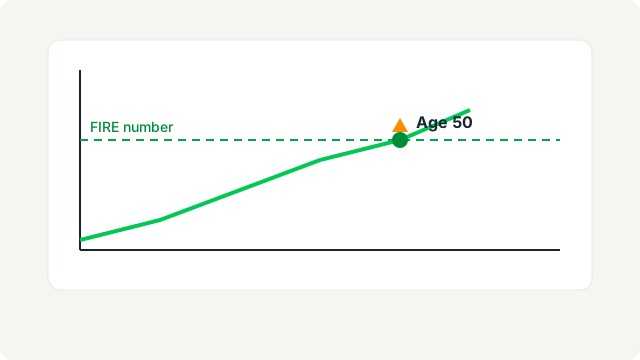
Spend $50,000 a year and save $40,000 of a $90,000 take-home and the regular FIRE number is $1,250,000. With $150,000 already invested and a 5% real return, that is 15 years 5 months, age 50.4. $12,000 a year of cash flow that keeps paying cuts the number to $950,000 and moves the age to 47.2. The savings rate on the default is 44.4%. Morningstar's 2026 safe starting rate is 3.9%, which nudges the same target to $1,282,051. The market does not owe you that path.
Last reviewed: November 2026. Illustration, not a forecast.
FIRE calculator
This FIRE calculator answers how big the portfolio has to be, and how many months of saving get you there. It is for someone who will type real spending, not a slogan. The FIRE number is spending divided by the withdrawal rate, after any cash flow that keeps paying. Months to FI add your savings at the end of each month. The honest catch: a smooth return is an illustration. Educational only. Not financial advice.
The Cash Flow Scout
FIRE calculator
Educational only. Not financial advice. Illustration, not a forecast.
Advanced
The CFS plan score is a rule of thumb, not advice.
Portfolio by age
Years to FI by savings rate
Contributions and growth
Check your retirement plan When does cash flow cover your bills?
Worked example: $90,000 take-home, $50,000 spending
The worked example in this FIRE calculator starts at age 35. Take-home $90,000. Spending $50,000. Invested $150,000. Real return 5%. Withdrawal rate 4%. Savings are $40,000 a year, which is $3,333.33 a month, a 44.4% savings rate.
The regular FIRE number is $1,250,000. The balance reaches it in 185 months (15 years 5 months), at age 50.4. The account then holds $1,250,202.53. Of that, $616,666.67 was contributed along the way and $483,535.86 was growth, on top of the $150,000 you started with. Those are the FIRE calculator defaults, not a prediction.
Lean spending of $37,500 needs $937,500 and lands at age 47.2. Fat spending of $75,000 needs $1,875,000 and lands at age 55.8. A $20,000 barista paycheck needs only $750,000 and lands at age 44.8. Add $12,000 of lasting cash flow and the regular lifestyle needs $950,000, reached at age 47.2.
The withdrawal ladder on $50,000 of spending is $1,538,461.54 at 3.25%, $1,428,571.43 at 3.5%, $1,250,000 at 4%, and $1,111,111.11 at 4.5%. Same life, different caution.
How to use this calculator
- Type take-home pay and the spending you actually want covered.
- Add investments you would sell from. Leave the house out.
- Pick a real return you can defend, and a withdrawal rate you can live with for a long retirement.
- Add cash flow that keeps paying, if you have it. Rent you might sell does not count the same way.
- Read the savings-rate table. Then open the bad-start stat before you circle a quit date.
- Save A and B if you want two plans side by side. Copy the link when you want these inputs again.
Leave a box blank and the FIRE calculator uses the defaults above. Change one input and the tables move together.
What the numbers mean
- FIRE number
- Spending the portfolio still has to fund, divided by the withdrawal rate.
- Savings rate
- Annual savings divided by take-home pay. This is the lever that moves the years.
- Real return
- Growth after inflation. Spending stays in today's dollars.
- Barista income
- Pay you plan to keep earning. It shrinks the number the way cash flow does, and it stops if the job stops.
- Bad-start delay
- Extra months if the first three years return -10% real and later years use your rate.
How to calculate your FIRE number
The FIRE calculator's short version is 25 times spending when the withdrawal rate is 4%. $50,000 times 25 is $1,250,000. That is the whole trick. Change the rate and the multiple changes: 3.25% is about 30.8 times spending, 3.5% is about 28.6 times, and 4.5% is about 22.2 times.
The FIRE calculator shows a ladder because people argue about 4%. The famous studies covered roughly 30-year retirements. Retiring at 50 can mean 40 or 45 years of withdrawals, plus health insurance before Medicare. A rate of 3.25% to 3.5% is the cautious end of the ladder on this page. It does not make you safe. It makes the number bigger so a bad sequence has more room.
Cash flow you do not sell changes the numerator, not the rate. If $12,000 a year already shows up, the portfolio only replaces $38,000. At 4% that is $950,000, not $1,250,000. The rate is still a guess. The subtraction is just arithmetic. The essay on cash flow versus the 4% rule walks through why those two ideas answer different questions.
Is the 4% rule still right in 2026?
For a 30-year retirement, 4% is still a reasonable starting point, and the research brackets it from both sides. Morningstar's base case for 2026 is a 3.9% starting withdrawal, built for a 90% chance of lasting 30 years. William Bengen, who first published the 4% rule in 1994, now puts the historical worst case at 4.7% for a more diversified portfolio. Retiring at 40 means planning for 50 years, which argues for the lower end.
| Withdrawal rate | Where it comes from | FIRE number |
|---|---|---|
| 4.7% | Bengen's updated historical worst case (30 years) | $1,063,830 |
| 4.0% | Bengen 1994 and the Trinity study (30 years) | $1,250,000 |
| 3.9% | Morningstar 2026 base case (30 years, 90% success) | $1,282,051 |
| 3.5% | A common cushion for 40 to 50 year early retirements | $1,428,571 |
| 3.25% | Very long horizon, or a retiree who wants room for bad decades | $1,538,462 |
The gap between the top and bottom rows is $474,632, which is several working years for most savers. That is the real argument for cash flow. Every $1,000 a year that a rental, a dividend stream, or a small business pays you reliably removes $25,000 from the target at 4%, and $28,571 at 3.5%. Use the withdrawal buttons in the calculator to see your own number move.
Sources: Morningstar retirement income research, Morningstar on early retirement withdrawal rates. Checked November 19, 2026.
Your savings rate decides your timeline
The FIRE calculator is blunt about this: the FIRE number gets the headlines. The savings rate does the work. On a $90,000 take-home, saving 10% means spending $81,000 and needing a huge portfolio, so the zero-start path takes 50.2 years at 5% real and a 4% withdrawal rate. Saving 50% means spending $45,000 and getting there in 16.3 years. Saving 70% takes 8.7 years. The months behind those years are 603, 196, and 104.
On the FIRE calculator, a spending cut works twice. You save the dollar you did not spend, and the number you are chasing gets smaller because spending is lower. A raise that you spend does neither. That is why the table from a zero balance is worth more than another decimal on the return. The heatmap on the tool varies both the savings rate and the real return so you can see which one moves the years.
The default saver is already at 44.4%, between the 40% row (21.2 years from zero) and the 50% row (16.3 years). They are not starting from zero. $150,000 invested is why their own path is 15.4 years instead of the zero-start table.
Lean, Fat, Barista, and Coast FIRE
The FIRE calculator's Lean path keeps the same withdrawal rate and trims spending to 75%. On the example that is $37,500 a year, a $937,500 number, and age 47.2. Fat FIRE does the opposite: 150% of spending, $1,875,000, age 55.8. Neither label tells you if the spending is realistic. It only scales the number.
The FIRE calculator's Barista path assumes you keep some pay. The default part-time line is $20,000, so the portfolio covers $30,000. The number falls to $750,000 and the age to 44.8. If that job disappears, you are back on the regular number. Treat barista income as a choice, not as a bond.
Coast FIRE is the cousin this page does not solve. Coast asks whether today's investments can grow to the number with no new savings, if you work only enough to pay the bills until then. The idea is spelled out in coast and barista FIRE with cash flow. Use this calculator for the full number and the savings path. Find the stop-saving age with the Coast FIRE calculator.
How cash flow lowers your FIRE number
The FIRE calculator's punchline: $12,000 a year of cash flow that keeps paying cuts the FIRE number from $1.25 million to $950,000 and gets this saver there about 3 years sooner (age 47.2 instead of 50.4). That is the whole Cash Flow Scout idea in one pair of ages. The portfolio is smaller because it no longer has to print the rent or the dividend.
A FIRE calculator only helps if the cash flow survives the retirement, not just the spreadsheet. A rental you plan to sell at 60 is a lump of principal, so it belongs in "invested now," not in the cash-flow box. Dividends you will spend, and rent after reserves, belong in the cash-flow box. Double counting the same dollars as both a portfolio balance and a yield is how people retire on paper a decade early.
Two related tools stay in their lanes. How much cash flow to quit your job turns a monthly gap into a pile of rentals or dividends. The financial freedom calculator dates the month those streams cover a goal. This page dates the month a portfolio, plus any cash flow you refuse to sell, covers spending.
What can go wrong
The FIRE calculator's default path assumes 5% real every year. Markets do not do that. The bad-start test reruns the same savings with the first three years at -10% real and the later years back at 5%. On the defaults that crossing moves from month 185 to month 206, a delay of 21 months. One bad start, not a forecast, and not a Monte Carlo. It is there so a smooth line does not feel like a schedule.
Health insurance before Medicare can dwarf a 0.25 point argument about withdrawal rates. The note on health insurance before 65 is the practical version of that problem. If you leave it out of spending, the FIRE number is a fiction.
The FIRE calculator leaves taxes out of the balance. A real return is not a tax return. Withdrawals from a traditional account are income. A taxable account throws off dividends you may not want to spend. Cash flow from rentals has vacancies, repairs, and debt. The score on this page does not know any of that. It only knows the five inputs you gave the grade.
Frequently asked questions
What is a FIRE number?
A FIRE number is the portfolio that can pay your spending at a withdrawal rate you pick. On the default inputs, $50,000 of spending at 4% is $1,250,000. Lean (75% of spending) is $937,500. Fat (150%) is $1,875,000. It is a planning target in today's dollars, not a promise the market will cooperate.
How do I calculate my FIRE number?
Divide the spending you still need to fund by the withdrawal rate. The default saver spends $50,000 and saves $40,000 of a $90,000 take-home (44.4%). At 4% the number is $1,250,000. With $150,000 already invested and $3,333.33 added each month at 5% real, the balance crosses that line in 185 months, at age 50.4, with $1,250,202.53 in the account.
Is the 4% rule safe for early retirement?
It is a rule of thumb from a 30-year retirement study, not a law and not a paycheck. A longer retirement is why this page also shows 3.25% ($1,538,461.54) and 3.5% ($1,428,571.43) on the same $50,000 of spending. 4.5% drops the number to $1,111,111.11 and leaves less room for a bad decade. Read the cash flow path versus the 4% rule before you treat 4% as spending money.
What savings rate do I need to retire early?
The FIRE calculator starts from a zero balance, this take-home, a 5% real return, and a 4% withdrawal rate. 10% saved takes 603 months (50.2 years). 20% takes 431 months (35.9 years). 40% takes 254 months (21.2 years). 50% takes 196 months (16.3 years). 70% takes 104 months (8.7 years). Spending cuts raise the savings rate and shrink the number at the same time.
What is the difference between Lean FIRE and Fat FIRE?
The FIRE calculator uses 75% of spending for Lean, so the default number is $937,500 and FI age is 47.2 (146 months). Fat uses 150%, so the number is $1,875,000 and FI age is 55.8 (249 months). Regular sits in the middle at $1,250,000 and age 50.4. Barista FIRE keeps $20,000 a year of part-time pay, which cuts the number to $750,000 and age 44.8.
Does rental income lower my FIRE number?
The FIRE calculator says yes, if the cash flow keeps paying and you do not sell the asset to fund spending. $12,000 a year drops the default number from $1,250,000 to $950,000 and the FI age from 50.4 to 47.2 (147 months, 12 years 3 months). $24,000 is the rental chip on this page. The portfolio only has to cover what the cash flow does not.
What safe withdrawal rate does Morningstar use for 2026?
Morningstar's 2026 base case is a 3.9% starting withdrawal, adjusted for inflation each year, with a 90% chance of lasting 30 years. Bengen's updated historical worst case is 4.7%. On $50,000 of spending, 3.9% means a FIRE number of $1,282,051 and 4.7% means $1,063,830. Early retirees with 40 or more years ahead often plan nearer 3.5%.
Should I use real or nominal returns?
The FIRE calculator uses a real return if spending is in today's dollars. The default is 5% after inflation, so there is no separate inflation box. A nominal return plus an inflation guess can land in the same place, but only if you inflate spending every year too. Mixing a nominal return with today's spending makes the timeline look shorter than it is.
What do the 3%, 3.5%, 3.75%, and 4% buttons do?
They set the withdrawal rate. The page still starts at 4% when that box is left alone, and a share link that omits the wr key does the same. On $50,000 of spending, 3% is $1,666,666.67, 3.5% is $1,428,571.43, 3.75% is $1,333,333.33, and 4% is $1,250,000. Rates under 4 percent are the cautious end for retirements longer than 30 years. Illustration, not a promise.
Educational only. Not financial advice. Returns are not guaranteed. Real retirements include taxes, health costs, and bad years this simple model does not capture.