

Real estate · The paper loss, then the bill
Rental Property Depreciation Calculator
Short answer
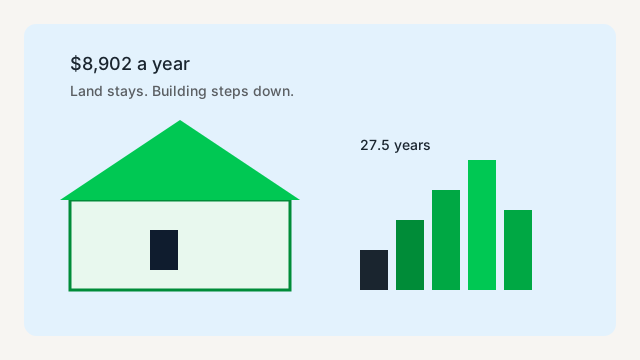
This is for a landlord who wants the paper loss without pretending it is cash. This $300,000 rental throws off $8,901.82 a year of depreciation, about $1,958.40 of tax savings at 22%. Sell after 10 years and roughly the same $18,523.20 comes back as recapture. Depreciation is a timing gift, not free money. The mid-month table and the assessor helper stay off until you turn them on, so that annual line does not move. Last reviewed: November 2026. Illustration, not a forecast.
Last reviewed: November 2026. Illustration, not a forecast.
Rental property depreciation calculator
If you need the 27.5-year schedule before a tax pro sees the file, start here. It uses the price, the closing costs you capitalize, the land share, and the month you placed the property in service. It estimates tax savings at your bracket and the recapture if you sell. Educational only. Not tax advice.
This schedule is an illustration, not a filing. Educational only. Not tax advice. Rules change and your situation matters, so check with a tax pro before filing. The 25% line is depreciation taken times 0.25. 25% is the top rate on unrecaptured section 1250 gain. Illustration. Check with a tax pro. It is not added to the annual deduction.
How to use this calculator
- Enter the purchase price and the closing costs you will capitalize. Leave loan fees out of that box. They are a different schedule.
- Set the land share from the assessor, not from a hope that the building is the whole price.
- Pick the month the property was available to rent. That month sets year 1, even if you closed on a different day.
- Choose a bracket and a sale year. Read the savings and the recapture together, or the gift looks bigger than it is.
- Add an improvement only if it is a capital project, with its own year and month.
- Use rent only as a yardstick. It does not change the schedule, and it does not pay the tax.
What the numbers mean
- Depreciable basis
- Price plus capitalized closing costs, minus the land share of that total. The example is $244,800.00. Land never joins this line.
- Full-year depreciation
- Basis divided by 27.5. The example is $8,901.82. Year 1 is smaller because of the mid-month rule.
- Tax savings
- Depreciation times your marginal rate, and only if you can use the deduction. Passive losses can push the benefit to a later year.
- Recapture estimate
- Accumulated depreciation through the sale year, times the lesser of your bracket and 25%. The timing gift comes back when you sell.
- Mid-month first year
- Basis times (12.5 minus the month) divided by 12, then divided by 27.5. The 12-row table is off until you turn it on. The annual line stays basis divided by 27.5.
- Assessor land ratio
- Assessor land divided by assessor total, when you opt in and total is above zero. That percent fills the land share. Purchase times (1 minus the ratio) is the building portion of the price alone.
- 25% recapture illustration
- Depreciation taken times 0.25. 25% is the top rate on unrecaptured section 1250 gain. Illustration. Check with a tax pro. It is not added to the annual deduction.
Worked example: $300,000 rental placed in service in July
The rental property depreciation calculator loads a $300,000 purchase, $6,000 of capitalized closing costs, a 20% land share, July as the in-service month, a 22% bracket, and a sale after 10 years. No improvement. Rent of $2,100 is only a yardstick.
Basis is $244,800.00. A full year is $8,901.82. Year 1, because of July and the mid-month rule, is $4,080.00. Year 2 is $8,901.82 again. The schedule runs 29 years and the last deduction is $370.91. Tax savings on a full year at 22% are $1,958.40. Year-1 savings are $897.60. After 10 years you have accumulated $84,196.36 of depreciation. The recapture estimate is $18,523.20. Ten years of tax savings at 22% are also $18,523.20. Net after recapture at the same 22% rate is $0.00.
Move one input. Placed in service in January, year 1 rises to $8,530.91. A $15,000 roof in year 3, placed in service in January, adds $522.73 of depreciation in its first year and $545.45 in a full year. The 10-year total, building plus roof, becomes $88,537.27. Land at 30% cuts the basis to $214,200.00. A 24% bracket raises full-year savings from $1,958.40 to $2,136.44. Same building, different facts.
None of those rows is a forecast of your tax bill. The rental property depreciation calculator does not know your other income, your state, or whether a passive-loss limit is sitting on the deduction. It shows the allowed depreciation and a plain recapture estimate so the timing is visible.
How rental depreciation works (27.5 years, mid-month)
Residential rentals use straight-line depreciation over 27.5 years. You do not pick a faster life because the property is old, and you do not slow it down because the tenant is careful. The rental property depreciation calculator divides the depreciable basis by 27.5 and calls that a full year. Each year after the first takes that full amount until the basis is gone. The last year takes whatever is left, which is why a July start ends in year 29 with $370.91 instead of a neat year 28.
The mid-month convention pretends you placed the property in service on the 15th of the month, even if you closed on the 1st or the 28th. Year 1 is basis times (12 minus the month plus 0.5) divided by 12, then divided by 27.5. July is 5.5 months out of 12, which is why $8,901.82 becomes $4,080.00. The half-month you did not get in year 1 is waiting in the final year. That is the whole convention. It is not a penalty and it is not a bonus.
The first-year table is off by default so a saved result does not move. Turn it on and you get one row per month. January is 3.485% of basis, which is 11.5 divided by 12, then divided by 27.5. December is 0.152%, which is 0.5 divided by 12, then divided by 27.5. On a $200,000 building basis, January is $6,969.70. The annual depreciation line is still basis divided by 27.5. Check with a tax pro before you file either number.
An improvement is a new asset. A $15,000 roof does not restart the building. It starts its own 27.5-year schedule in the year and month you place it in service, with the same mid-month fraction. A repair that keeps the property in ordinary condition is usually an expense in that year, not a new 27.5-year asset. Paint, a broken lock, and a service call belong in the operating budget. A new roof, a new HVAC system, and a kitchen that is a betterment usually belong on the depreciation schedule. The line between them is a tax question. This rental property depreciation calculator will take whatever number you type. It will not audit it.
Cost segregation and bonus depreciation exist. The rental property depreciation calculator does not price a study. A study can move some of the purchase price into 5-year, 7-year, or 15-year property, and some of that personal property has been eligible for bonus depreciation in some years. This page does not model either one, and it does not quote a percent. Ask a CPA if the building is large enough for the study to matter. Land still never depreciates, study or no study.
Finding your basis and land value
Basis starts with what you paid, plus costs that the tax rules say to capitalize, minus land. On the rental property depreciation calculator that is (price + capitalized closing) times (1 minus the land percent). $306,000 times 0.80 is $244,800.00. If you inherited the property or received it in a like-kind exchange, the starting basis is a different number. Do not type the old owner's price and hope. Get the basis from the closing file or from the prior return.
Land value is the part people fudge. A bigger building share means a bigger deduction, so the temptation is to call the lot 5%. The assessor often prints a land value and an improvement value on the tax bill or the property card. Use that ratio unless you have an appraisal that splits them. The rental property depreciation calculator's land slider runs from 0% to 60% so you can see the basis move. Zero is allowed by the math and is rarely honest. If the lot is half the price, type 50 and accept the smaller schedule.
The assessor helper is off by default, so the land slider stays in charge. Turn it on and enter the assessor land value and the assessor total. The ratio is land divided by total when total is above zero. That ratio fills the land share. It does not replace the land box. Purchase times (1 minus the ratio) is the building portion of the purchase price. The schedule still uses price plus capitalized closing, times one minus the filled land share. Check with a tax pro if the card and the closing file disagree.
On the rental property depreciation calculator, closing costs are not one bucket. Some title charges, transfer taxes, and recording fees are added to basis. Loan origination fees, mortgage insurance, and prepaid interest are not building basis. Prepaid property tax might be an expense. The $6,000 in the example is a stand-in for the costs you have already decided to capitalize. If you are unsure, the safe move is to leave the box at the number your tax pro capitalized last time, not the number that makes year 1 look larger.
How much tax depreciation saves
The deduction saves tax only when it reduces income you would have paid tax on. A full year of $8,901.82 at 22% is $1,958.40. At 24% it is $2,136.44. At 12% it is less. The rental property depreciation calculator multiplies and stops. It does not stack the standard deduction, the qualified business income deduction, or state tax. Those can raise or lower the real savings. Treat the dollar as an estimate.
Passive activity rules are the part that surprises W-2 owners. Rental losses are passive unless you qualify as a real estate professional under the hours tests. There is a special allowance of up to $25,000 of rental loss against other income, and it phases out as modified adjusted gross income moves from about $100,000 to $150,000. Above that, the loss often carries forward until you have passive income or you sell. The rental property depreciation calculator's "annual tax savings" line assumes the deduction is usable this year. If it is not, you still have the carryforward, and you still have the recapture later. The cash did not arrive just because the form showed a loss.
A paper loss and a cash loss are different animals. Depreciation is not a check you write. The tenant's rent still has to cover the mortgage, tax, insurance, and repairs. If the property already loses cash, depreciation does not fix the leaking roof's invoice. It may lower the tax on your other income, which is useful, and it may not, which is also common. Read the savings next to the cash flow, not instead of it.
Depreciation recapture when you sell
Sell the rental and the depreciation comes back into the tax conversation. The simple version on this rental property depreciation calculator is accumulated depreciation times the lesser of your bracket and 25%. After 10 years that accumulated figure is $84,196.36, and at 22% both the savings and the recapture estimate are $18,523.20. You had the use of the deduction for up to 10 years. You did not get to keep the tax forever, not at the same rate, and not in this simplified model.
On the rental property depreciation calculator the real form is still pickier than the estimate. Unrecaptured section 1250 gain is taxed at up to 25%, and gain above the depreciation can be long-term capital gain. Selling costs reduce the amount realized. A 1031 exchange into another rental can defer both, if the replacement property and the timing qualify. Holding until death can change the basis for your heirs under current rules. None of that is modeled here, and none of it is advice. The guide on a 1031 exchange into multifamily explains the deferral idea in plain words. Run the rental property depreciation calculator before you assume the sale is tax-free.
If your bracket at sale is higher than the bracket while you held the property, the recapture estimate can exceed the savings you actually enjoyed. The rental property depreciation calculator uses one bracket for both, which is why the default net is $0.00. Change the story in your head if you took the deduction at 22% and sell in a 32% year. The 25% cap in the formula is why a 32% or 37% bracket does not multiply the whole accumulated amount by 37%. That cap is a simplification of the unrecaptured 1250 rate, not a promise about your return.
A separate line multiplies depreciation taken by 0.25. 25% is the top rate on unrecaptured section 1250 gain. Illustration. Check with a tax pro. That dollar is not added to the annual deduction. On a $200,000 basis placed in service in January, the first year is $6,969.70 and 25% of that one year is $1,742.42. Your return can be lower. It will not be this simple.
Depreciation and cash flow
Cash flow is rent minus the bills you pay. The rental property depreciation calculator does not pretend otherwise. Depreciation is a non-cash deduction. A property can show a tax loss and still deposit money, or show taxable income and still eat cash, depending on the loan and the repairs. The rental property depreciation calculator does not compute the mortgage. Pair it with the cash-flow view on rental property cash flow so you do not confuse a paper loss with money in the account.
On the example, a full year of depreciation is $8,901.82. Against $2,100 a month of gross rent, that is about 35% of a year's rent. That percent is a yardstick, not a target. It does not mean 35% of the rent is sheltered. Operating expenses, interest, and the passive-loss rules all sit between the schedule and your refund. The monthly "boost" of about $163 is $1,958.40 divided by 12, and only if the deduction is usable. If it is not usable, the boost this year is zero and the carryforward is the asset.
Investors who buy for cash flow still need the schedule, because the IRS assumes you took it. Skipping depreciation to "keep it simple" can mean paying tax twice: once while you hold, by missing the deduction, and again at sale, through recapture of the amount you were allowed. The rental property depreciation calculator is the picture of that allowed amount. Your preparer is the person who puts it on the form.
Frequently asked questions
How do you calculate depreciation on a rental property?
Add capitalized closing costs to the purchase price, take out the land share, and divide by 27.5. On this rental property depreciation calculator a $300,000 price plus $6,000 of closing costs and 20% land leaves a $244,800.00 basis. A full year is $8,901.82. Placed in service in July, year 1 is $4,080.00 because of the mid-month convention. Year 2 is the full $8,901.82.
Why 27.5 years?
Residential rental real estate uses a 27.5-year straight-line life under the current federal rule for property placed in service after 1986. The rental property depreciation calculator does not shorten that life. A roof, a kitchen, and the building all ride the same 27.5-year clock unless a cost-segregation study breaks out shorter-lived pieces. That study is a CPA job. This page does not invent one.
Can I depreciate land?
No. Land does not wear out in the tax code, so it never enters the schedule. The rental property depreciation calculator takes land as a percent of price plus capitalized closing costs. At 20% the basis is $244,800.00. At 30% it is $214,200.00. Use the county assessor split, not a wish. A higher land share means less depreciation and less of a paper loss.
What is the mid-month convention?
The IRS treats the building as placed in service in the middle of the month you put it in service, no matter the day. July is month 7, so year 1 gets (12 - 7 + 0.5) / 12 of a full year, which is $4,080.00 on the example. January gets $8,530.91. The missing piece shows up in the last year. This example's last year is year 29, and the last deduction is $370.91.
What is depreciation recapture?
When you sell, the depreciation you took (or were allowed to take) can be taxed as unrecaptured section 1250 gain, often at up to 25%. The rental property depreciation calculator estimates that as accumulated depreciation times the lesser of your bracket and 25%. After 10 years the accumulated amount is $84,196.36. At 22% the tax savings along the way are $18,523.20 and the recapture estimate is the same $18,523.20. Net is $0.00. The value was the timing, not a gift that disappears the tax.
Can depreciation offset my W-2 income?
Sometimes, and often not. Rental losses are usually passive. A special allowance of up to $25,000 can offset other income, and it phases out between about $100,000 and $150,000 of modified adjusted gross income. Real estate professional status is a different set of rules. The rental property depreciation calculator multiplies depreciation by your bracket and does not model those limits. At 22%, a full year is about $1,958.40 of tax savings only if you can use the deduction. Ask a tax pro.
Do I have to take depreciation?
You do not have to claim it on the return, but the IRS can still recapture the depreciation you were allowed to take when you sell. Skipping it does not skip the recapture. The rental property depreciation calculator shows the allowed amount so you can see the schedule. It is not a filing position. Check with a tax pro before you leave a deduction on the table or before you sell.
What does the mid-month table add?
The table is off by default, so the annual depreciation line does not move. Turn it on to see 12 first-year rows. The fraction is (12.5 minus the month) divided by 12, then divided by 27.5. January is 3.485% of basis (11.5/12/27.5). December is 0.152% (0.5/12/27.5). On a $200,000 basis, January is $6,969.70. Check with a tax pro.
How does the assessor land helper work?
It is off by default and does not replace the land slider. Turn it on and enter assessor land and assessor total. When total is above zero, the ratio is land divided by total, and that percent fills the land share. Purchase times (1 minus the ratio) is the building portion of the price. The schedule still uses price plus capitalized closing, times one minus that land share.
What is the 25% recapture line?
It is depreciation taken through the sale year, times 0.25. 25% is the top rate on unrecaptured section 1250 gain. Illustration. Check with a tax pro. It is not added to the annual deduction. On a $200,000 basis placed in service in January, one year is $6,969.70 and 25% of that year is $1,742.42.
More free tools: CapEx reserve · Rental portfolio · Roth IRA rental
Educational only. Not tax advice. Rules change and your situation matters, so check with a tax pro before you file or before you spend a paper loss.